Yield to maturityWhy bond price alters your return
Yield to maturity is the total annual rate of return you earn on a bond if you buy it at today's price and hold it until the issuer pays it off in full. It matters because fixed bond payments produce higher or lower annual returns depending entirely on what price you pay to buy them. If you buy a bond for less than its face value, your yield to maturity ends up higher than its fixed coupon rate.
By the edgi team We find the most surprising true thing about an idea and build a 60-second lesson around it.
A bond with a $1,000 face value may promise a 4 percent coupon, or $40 a year. That $40 payment does not change when the bond changes hands. A buyer might pay $900, $1,000, or $1,100 for the bond. The price depends on what those fixed payments are worth in the market now.
A strip of four uncut bond coupons from a 1922 Mecca Temple construction bond, each for $2.50. Timothy Buchman Stagehand 16:19, 21 November 2006 (UTC), Public domain, via Wikimedia Commons
Yield to maturity combines the purchase price, the $40 coupon payments, the $1,000 repayment, and the time left into one annual return.
How price changes the yield
A buyer who pays $900 still receives $40 a year and $1,000 at maturity, if the issuer makes every promised payment. The extra $100 returned at maturity adds to the buyer's return. The yield to maturity is therefore higher than the 4 percent coupon.
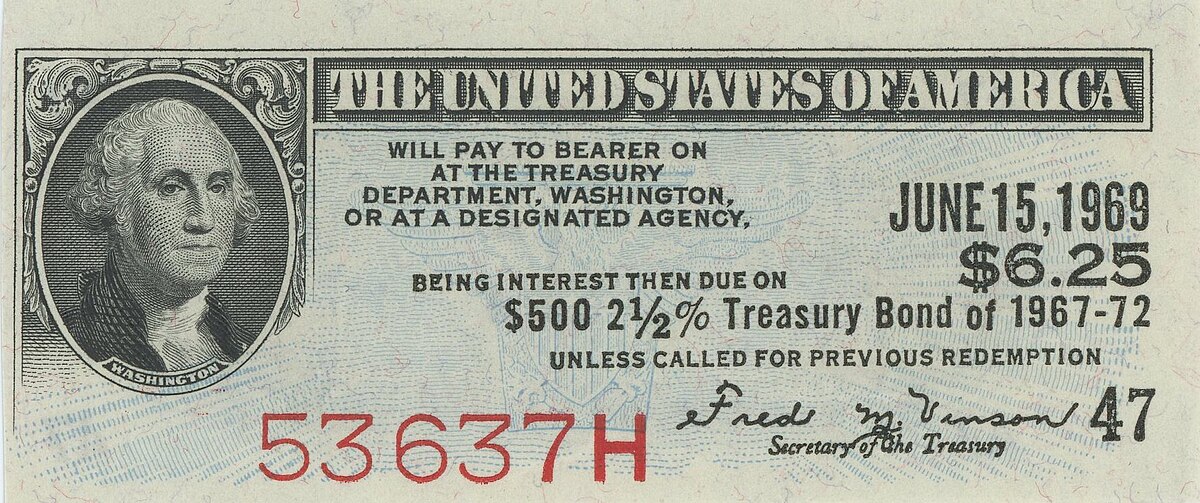
A 1945 2.5% $500 Treasury Bond coupon, featuring a portrait of George Washington on the left and details of the bond on the right. JHerbstman, Public domain, via Wikimedia Commons
A buyer who pays $1,100 receives the same $40 payments and $1,000 at maturity. That buyer's yield is lower than 4 percent.
What the number assumes
For the same promised payments, a lower price produces a higher yield to maturity. A higher price produces a lower yield. The calculation assumes the buyer holds the bond until maturity and receives the promised payments.
Putting price, payments, and time into one annual rate makes bonds with different coupons and maturity dates easier to compare.
A screen displaying VisiCalc, an early spreadsheet program, with a green-on-black interface. User:Gortu, Public domain, via Wikimedia Commons
How bond price changes the yield
A bond's coupon payment is fixed when the bond is issued, but its market price fluctuates. Yield to maturity is the discount rate that makes the present value of all future payments equal to the current market price.
When a bond's price drops below its face value, the bond sells at a discount, and its yield to maturity rises above the coupon rate. When its price rises above face value, it sells at a premium, and the yield falls below the coupon rate. When the market price matches the face value exactly, the bond sells at par, and the yield equals the coupon rate.
The assumptions behind the calculation
The calculated yield will only match your actual return if every condition holds: the bond is held until maturity, the issuer never defaults, and interest payments are received on time.
Traditional formulas assume you reinvest every interest payment at that exact yield rate with zero transaction costs. In real markets, future reinvestment rates are unknown, exposing investors to reinvestment risk. Quotes are also gross redemption yields, omitting taxes and dealing fees.
Variants for early repayments
Bonds with special features use modified calculations because their cash flows can end early. A callable bond lets the issuer pay off the debt early, so investors calculate yield to call (YTC) based on that shortened timeline.
A puttable bond lets the investor sell the bond back to the issuer early at a set price, creating a yield to put (YTP). Yield to worst (YTW) identifies the lowest potential return among all possible call dates, put dates, and maturity.
Test yourself
How does yield to maturity help investors compare two bonds with different prices and coupon rates?
It combines price, payments, and time into one rate.. Yield to maturity merges purchase price, coupon payments, final repayment, and remaining time into a single annualized return, enabling direct comparison across different bonds.
When a bond's purchase price drops below its face value, does its yield to maturity increase or decrease?
Increase. Paying less than face value while receiving the same final payout adds a capital gain to your total return, which raises the yield to maturity above the coupon rate.
Why can a $1,000 bond bought for $900 have a higher YTM?
The buyer gets $1,000 after paying $900. The buyer receives the same promised coupons and principal, but pays less up front. The gap between $900 and $1,000 contributes to the return.
Play the lesson in edgi and the card is yours. It lands on your Map next to the ideas it connects to, and turns from matte to foil to gold as you learn more around it.
What is the difference between yield to maturity and coupon rate?
The coupon rate is the fixed annual payment printed on the bond divided by its face value. Yield to maturity measures your actual annual return based on the market price you paid, the payments received, and the time remaining.
What is gross redemption yield?
It is another name for yield to maturity quoted before accounting for taxes paid on the returns. It also leaves out any transaction or brokerage fees incurred when buying or selling the bond.
What is yield to worst?
Yield to worst is the lowest potential yield a bondholder could receive when a bond includes early redemption options. It compares yield to maturity, yield to call, and yield to put to identify the lowest outcome.