Animal echolocation, also called bio sonar, is a biological system where animals produce their own sounds and listen to returning echoes to locate objects around them. By comparing the tiny time delays and loudness differences between their two ears, animals can determine an object's distance, horizontal angle, size, and speed. It enables creatures to hunt and travel in complete darkness or murky water where eyesight is useless.
By the edgi team We find the most surprising true thing about an idea and build a 60-second lesson around it.
In 1793, Italian scientist Lazzaro Spallanzani discovered that blinded bats could still navigate and hunt perfectly. However, when he plugged their ears with wax, they crashed helplessly into walls.
It took another 150 years for Donald Griffin to prove they were shouting at frequencies humans cannot hear.
A spectrogram displays the vocalizations of a Pipistrellus pipistrellus bat during prey approach, showing frequency on the Y-axis (from 0 to 120 kHz) and time on the X-axis (from 0 to 1.0 s). Drahkrub Attribution must include the URL http://de.wikipedia.org/wiki/Benutzer:Drahkrub, CC BY-SA 4.0, via Wikimedia Commons
How it works
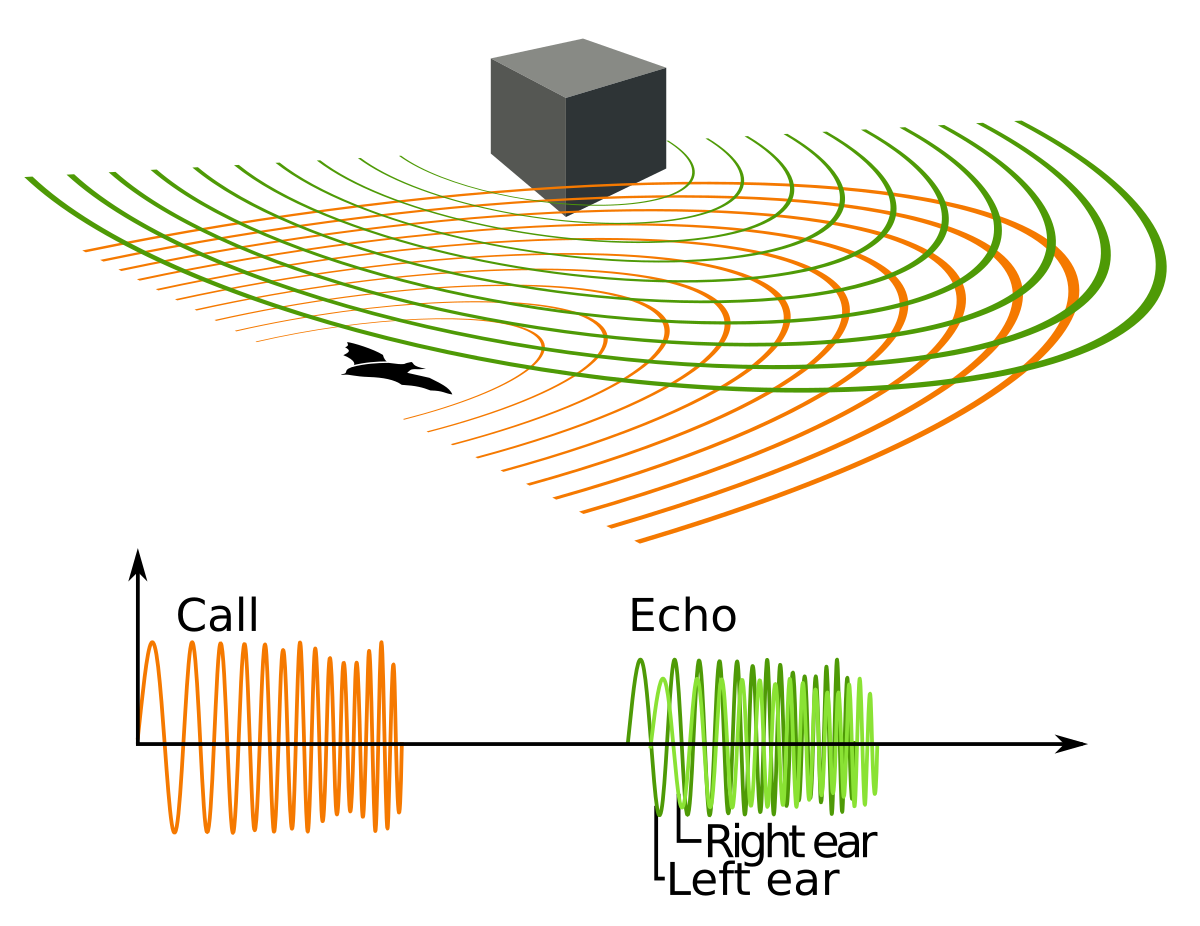
Echolocating animals emit sharp calls and listen to the bouncing echoes to locate objects. By analyzing the tiny delay in the returning sound waves, they calculate exact distances in milliseconds.
Diagram illustrating animal echolocation, showing a bat emitting ultrasound signals and receiving echoes from a cube-shaped object. Petteri Aimonen, Public domain, via Wikimedia Commons
They also use Frequency Modulation, sliding their pitch down mid-screech to pinpoint a target's speed and size.
The underwater world
Marine mammals like the dolphin use a similar mechanism beneath the ocean surface. A dolphin can use echolocation to detect a ping-pong ball from a hundred yards away in murky water.
Animated diagram illustrating biosonar by cetaceans, showing a yellow fish in blue water being detected by the skull of an orca. Malene Thyssen, CC BY-SA 3.0, via Wikimedia Commons
Their acoustic image is so precise it rivals human vision, turning sound into sight.
How bio sonar calculates distance and direction
Animal echolocation operates as an active sonar system with one transmitter and two receivers. The animal produces a sound, which bounces off nearby obstacles or prey and returns to its ears. Because the two ears are separated in space, the returning echoes arrive at slightly different times and intensities, providing the precise horizontal angle of the target.
The animal measures the total time delay between emitting the call and hearing the echo to calculate distance. This process takes only milliseconds, allowing the animal to perceive where an obstacle lies, how large an object is and what type of creature it is encountering.
Frequency sweeps and constant tones
Echolocation calls rely on two basic frequency structures: frequency modulated (FM) sweeps and constant frequency (CF) tones. An FM call sweeps downward across a wide range of frequencies, offering precise range detail in close, cluttered spaces. A CF call holds a steady tone, which lets the animal detect prey speed and body movements using the Doppler effect in open areas.
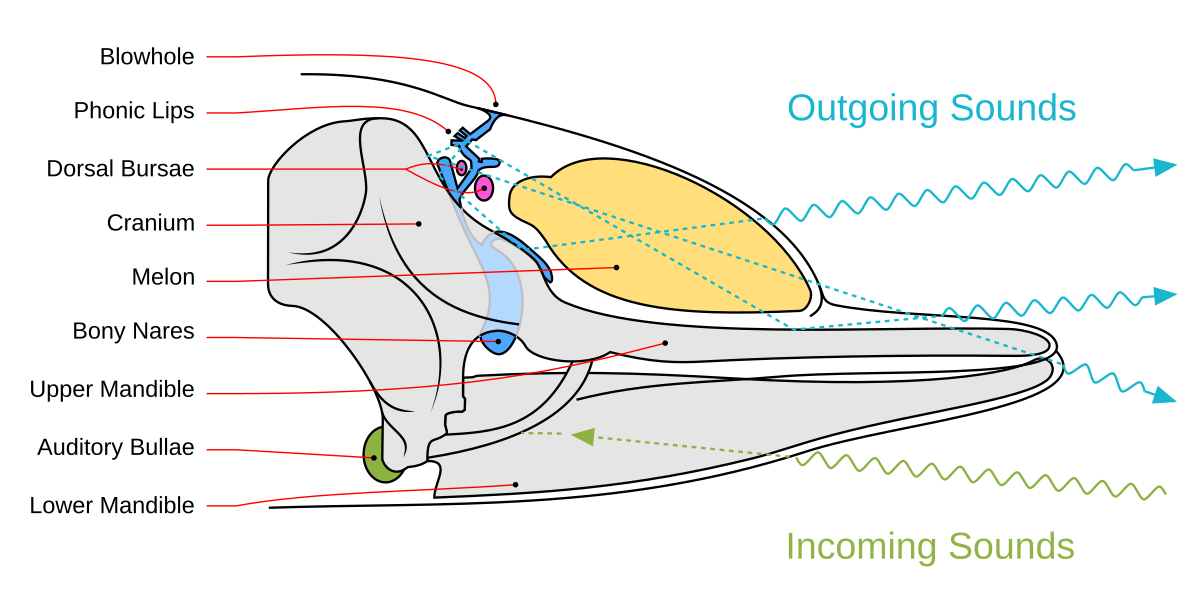
A toothed whale projects outgoing acoustic signals (cyan) through its forehead and receives returning echoes (green) along its lower jaw. Jooja, CC BY-SA 4.0, via Wikimedia Commons
Bat calls range widely from 11 kHz to 212 kHz, with volumes spanning 60 to 140 decibels. Some species adjust their volume mid-call, dropping intensity as they close in on an object so the powerful returning echo does not deafen them. Open-air hunters use high-intensity calls around 133 decibels to overcome sound absorption in air, while whispering bats use low-amplitude calls to sneak up on moths.
Which animals use echolocation?
Echolocation is most prominent in bats and odontocetes (toothed whales, such as porpoises and dolphins). Simpler versions exist in small terrestrial mammals like shrews, as well as two groups of cave-dwelling birds: cave swiftlets and the oilbird.
The elongated hindwing tails of the African moon moth oscillate during flight to deflect a hunting bat's strikes away from its body. Ichwarsnur, CC BY-SA 4.0, via Wikimedia Commons
Prey species have evolved defenses against this acoustic hunting. Certain moths use long oscillating wing tails to deflect bat attacks, while others emit ultrasonic clicks to warn bats, mimic bad-tasting species, or jam the bat's bio sonar entirely.
Test yourself
When an animal uses echolocation, which sensory cue provides the distance measurement to a target?
The time delay of returning echoes. Animals calculate exact distances by measuring the tiny time delay between emitting a call and hearing the echo return.
How does frequency modulation assist an animal during echolocation?
It slides pitch to track target speed. Sliding the pitch down mid-screech allows the animal to pinpoint a moving target's speed and size from the returning waves.
In animal echolocation, what primary cue reveals the exact distance to an object?
The delay time of returning echoes. Animals measure the tiny time gap between emitting a sound and hearing its echo to calculate distance in milliseconds.
Play the lesson in edgi and the card is yours. It lands on your Map next to the ideas it connects to, and turns from matte to foil to gold as you learn more around it.
Italian scientist Lazzaro Spallanzani showed in 1793 that blinded bats could hunt, but ear-plugged bats could not. In 1798, Louis Jurine concluded bats rely on hearing, and in 1944, Donald Griffin and Robert Galambos proved bats emit ultrasonic calls above human hearing, with Griffin coining the term echolocation.
Why do some bats use sounds that humans could hear?
While most bats call above human hearing limits, the spotted bat (Euderma maculatum) uses a low frequency of 12.7 kHz. This lower frequency tone cannot be heard by the moths it targets, allowing the bat to approach undetected.
How long do animal echolocation calls last?
A single call lasts between under 3 milliseconds and over 50 milliseconds. FM bats generally produce short pulses of around 3 milliseconds, whereas CF bats emit continuous tones lasting up to 52 milliseconds.