Convergent evolution is the independent development of similar traits in species from completely different evolutionary branches. It happens because organisms face the same physical and environmental pressures, leading natural selection toward the same practical solutions. As a result, distantly related creatures often end up with nearly identical anatomy.
By the edgi team We find the most surprising true thing about an idea and build a 60-second lesson around it.
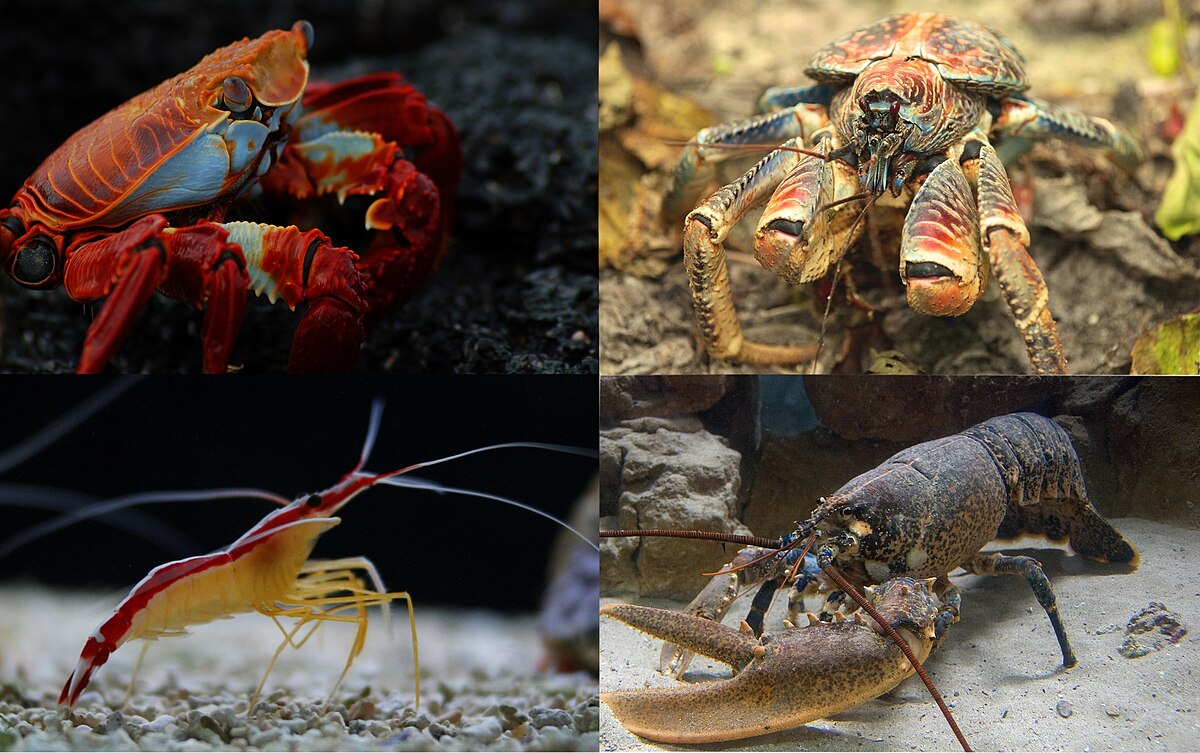
In 1916, biologist L.A. Borradaile noticed that evolution keeps turning animals into crabs. It is called carcinization. At least five distinct groups of crustaceans have evolved the same flat, circular shell and tucked-under tail independently.
A montage of four different decapod crustaceans: a red crab with blue claws (top left), a terrestrial crab (top right), a white and red banded shrimp (bottom left), and a lobster (bottom right). File:Sally Lightfoot crab (4202519454).jpg: Magnus Manske (uploader), Original by Peter Wilton [1] File:Christmas Island, CC BY-SA 4.0, via Wikimedia Commons
The evolutionary filter
Convergent evolution happens because there are only so many ways to solve a biological problem. If you need to fly, you need wings. If you need to see, you need a lens. Natural selection filters out inefficient designs, leaving only the winners.
Distant cousins
It explains why a sugar glider and a flying squirrel look like twins, despite one being a marsupial and the other a rodent. They are travelers from different evolutionary paths who arrived at the same destination because it is the only design that works.
How analogous traits develop
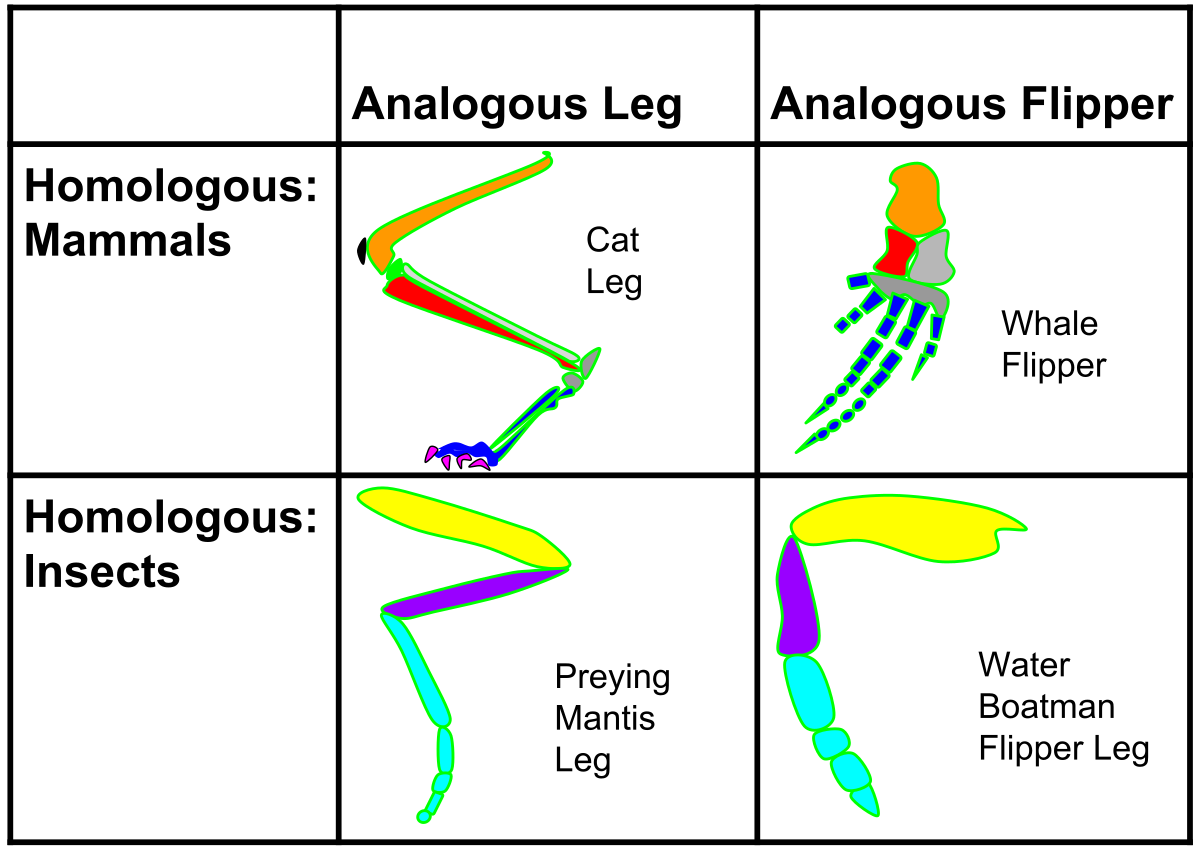
Analogous structures share a form or function but were absent in the last common ancestor of the species that carry them. The British anatomist Richard Owen first identified the difference between these analogous traits and homologous traits, which share common ancestral roots.
The horizontal axis shows homologous structures that share ancestry but differ in function, while the vertical axis shows analogous structures that evolved independently to perform the same role. Vanessablakegraham, CC BY-SA 4.0, via Wikimedia Commons
Flight provides a clear example: birds, bats, pterosaurs, and flying insects evolved wings on separate evolutionary paths. While bird, bat, and pterosaur wings are analogous as flight surfaces, their forelimbs remain homologous because they inherit their underlying bone structure from a common ancestor.
In cladistics, these convergently evolved features are called homoplasies. Because homoplasies mimic true ancestral relationships, they can confound biologists trying to map evolutionary trees.
Convergence at the molecular level
Convergent evolution is not limited to whole organisms; it also happens inside single molecules. Strict physical and chemical laws restrict how enzymes can function, forcing separate protein lineages toward identical active sites.
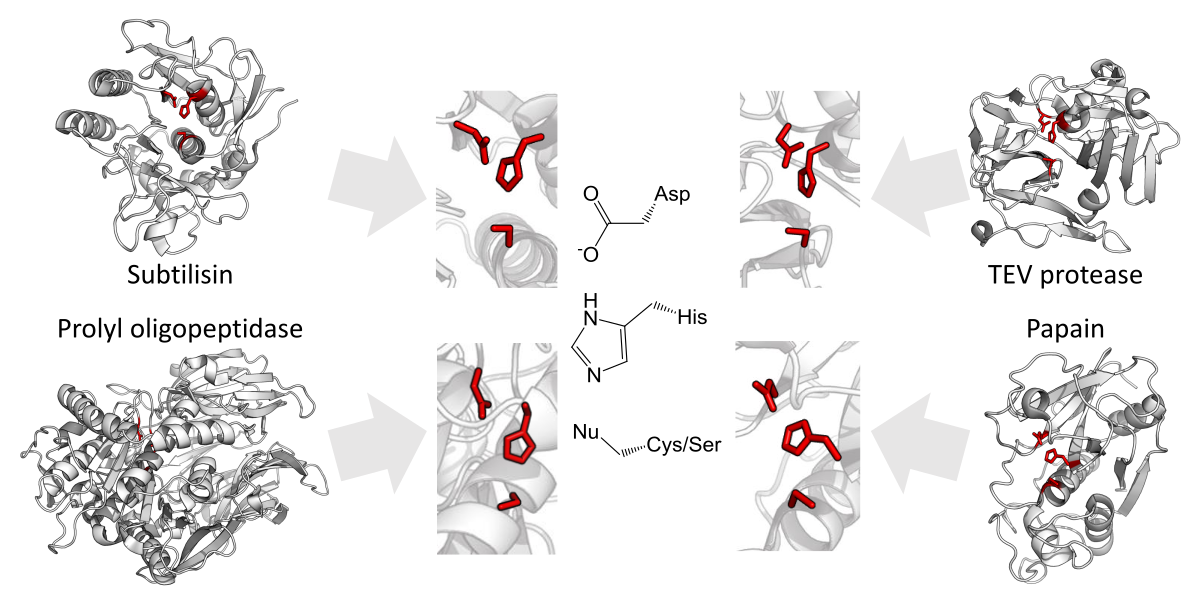
Different protease superfamilies independently arranged their amino acids into the exact same catalytic triad to catalyze reactions. Thomas Shafee, CC BY 4.0, via Wikimedia Commons
Serine and cysteine proteases assemble an acidic, a basic, and a nucleophile residue into a catalytic triad. The chemical constraints on enzyme catalysis caused this exact triad arrangement to evolve independently more than 20 times across different enzyme superfamilies.
Similar convergence appears in venom chemistry. The cone snail Conus geographus produces an insulin variant that closely matches the insulin sequences of fish rather than those of related molluscs.
How plants and marsupials converge
Distinct plant lineages repeatedly arrive at identical solutions for survival. Plants independently developed C4 photosynthesis, carnivory, and fleshy fruits designed for animal seed dispersal.
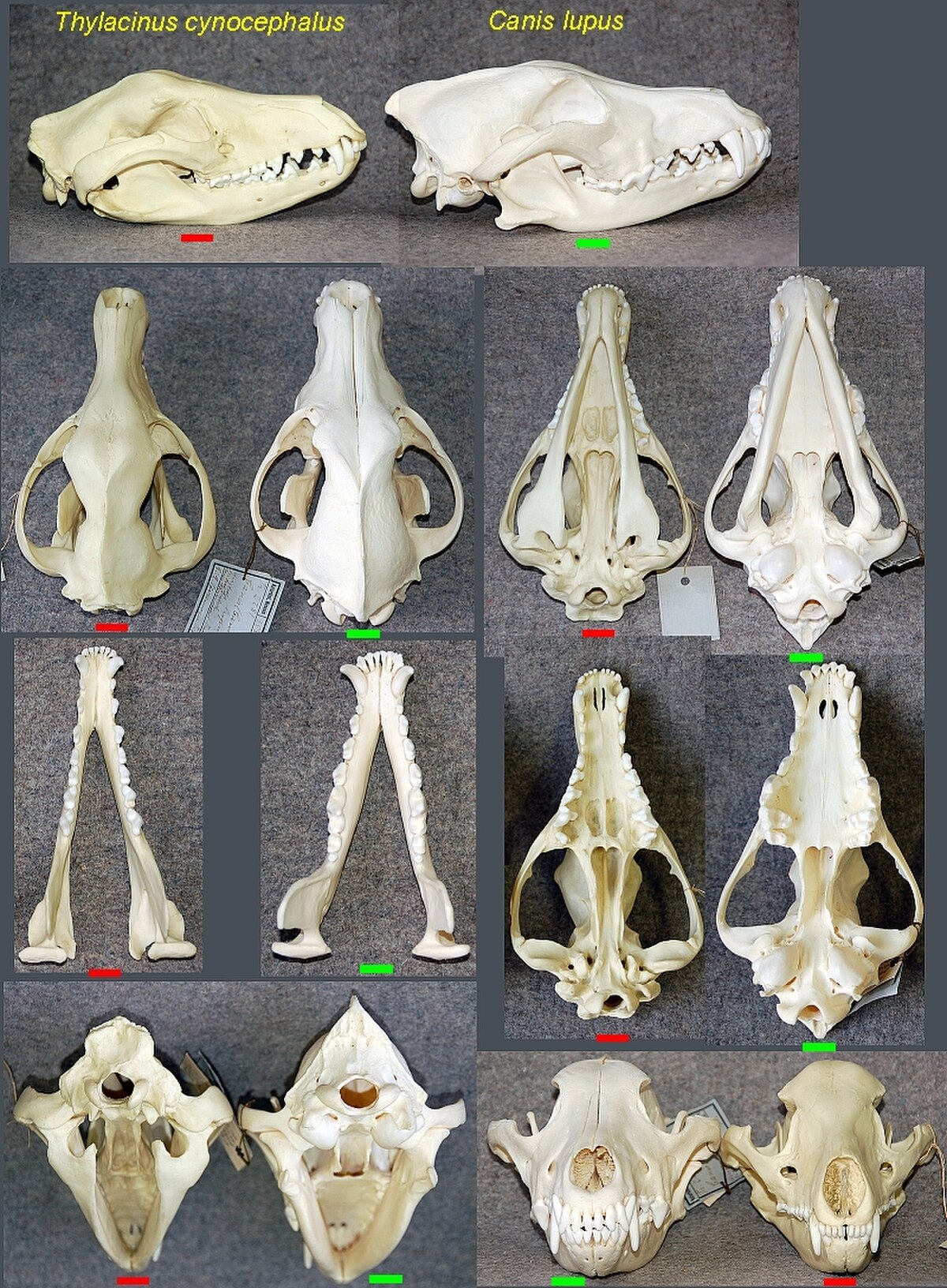
Skulls of the marsupial thylacine and the placental gray wolf reveal nearly identical shapes resulting from independent adaptation to predatory life. Fritz Geller-Grimm, CC BY-SA 2.5, via Wikimedia Commons
Marsupials and placental mammals provide another striking case. The marsupial thylacine and the placental gray wolf developed matching carnivorous skull shapes and body forms despite evolving independently on separate continents.
Test yourself
What drives convergent evolution in unrelated lineages?
Identical environmental pressures. Convergent evolution happens because similar environmental challenges force different lineages toward the same efficient physical solution, not because of shared genetics.
How does convergent evolution produce analogous structures in completely unrelated species?
Natural selection filters for optimal designs. Natural selection acts as an evolutionary filter, eliminating inefficient body plans and leaving similar winning designs across different lineages.
Did crabs evolve from a single common ancestor that split into five groups?
No, they evolved it five separate times. Carcinization happened independently across multiple distinct crustacean lineages, proving the shape is a forced winning design rather than a family trait.
Play the lesson in edgi and the card is yours. It lands on your Map next to the ideas it connects to, and turns from matte to foil to gold as you learn more around it.
What is the difference between convergent and parallel evolution?
Parallel evolution occurs when two species with similar ancestors evolve in the same direction, like gliding frogs emerging from multiple tree frog types. Convergent evolution occurs when species that lacked similar ancestral traits develop matching characteristics.
What is divergent evolution?
Divergent evolution is the opposite of convergent evolution. It happens when related species that share a common ancestor develop different traits over time.
What is an atavism?
An atavism is a trait that reappears after having been lost in earlier generations. This occurs when an unused gene that remained in the genome is switched back on, a process possible in mammals and birds for around 6 million years.