Electroreception is the biological ability to detect electrical fields in the surrounding environment. Water conducts electricity far better than air, allowing aquatic animals to track prey without relying on eyesight. Some species can even project their own electric fields to scan their surroundings.
By the edgi team We find the most surprising true thing about an idea and build a 60-second lesson around it.
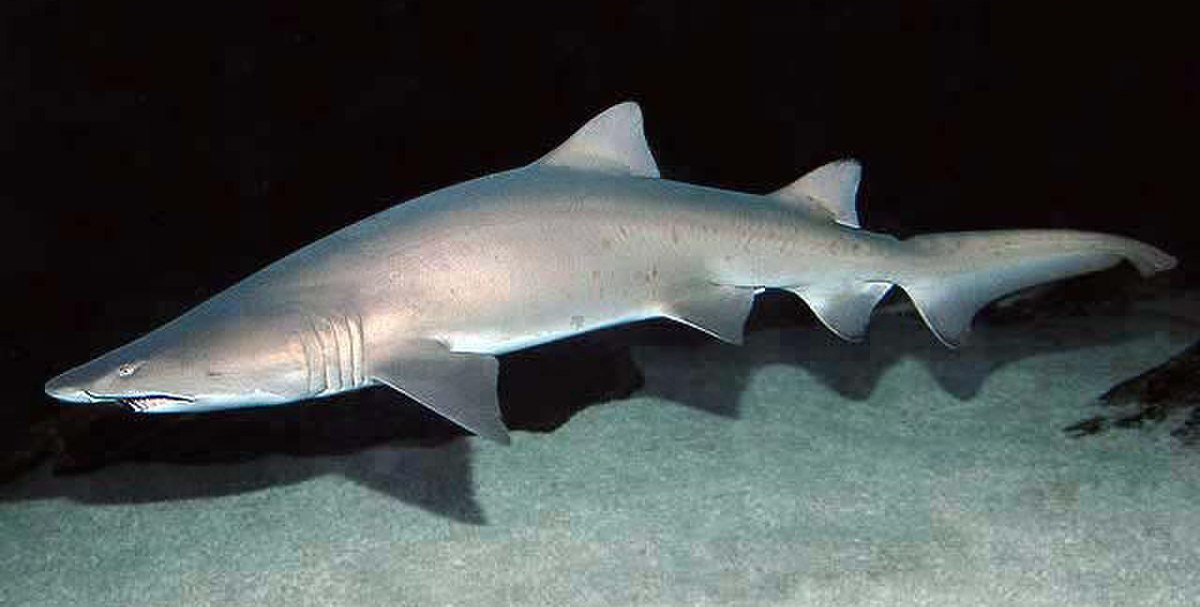
Even in pitch-black water, a shark can hunt down a fish buried completely under the sand. Every movement, heartbeat, and gill twitch generates a tiny electrical field in the water.
Underwater photograph of a sand tiger shark (Carcharias taurus) swimming over a sandy bottom in dark water. D Ross Robertson, Public domain, via Wikimedia Commons
Predators have evolved specialized organs that turn this ambient noise into a glowing map of invisible energy.
The pores on the snout
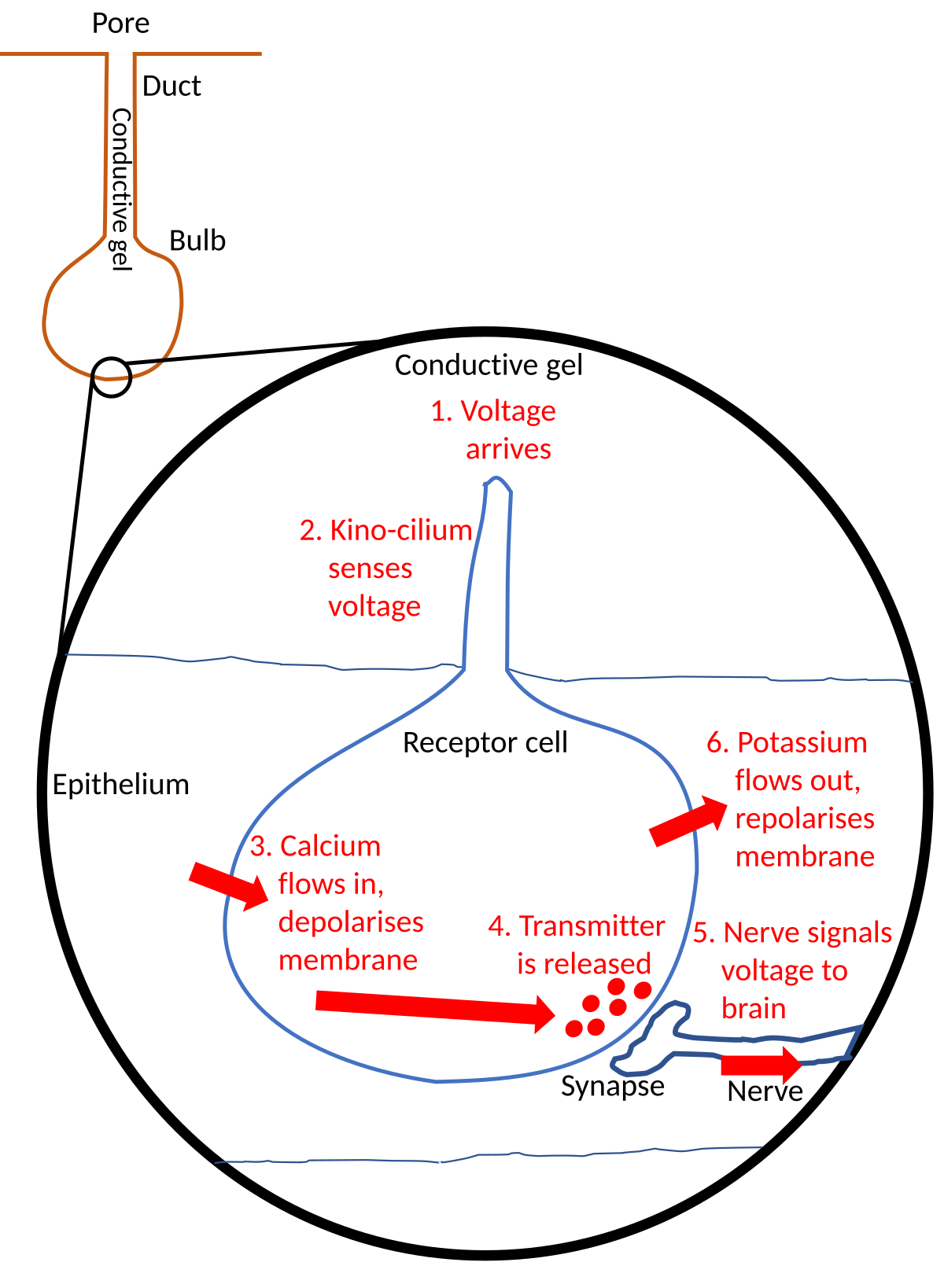
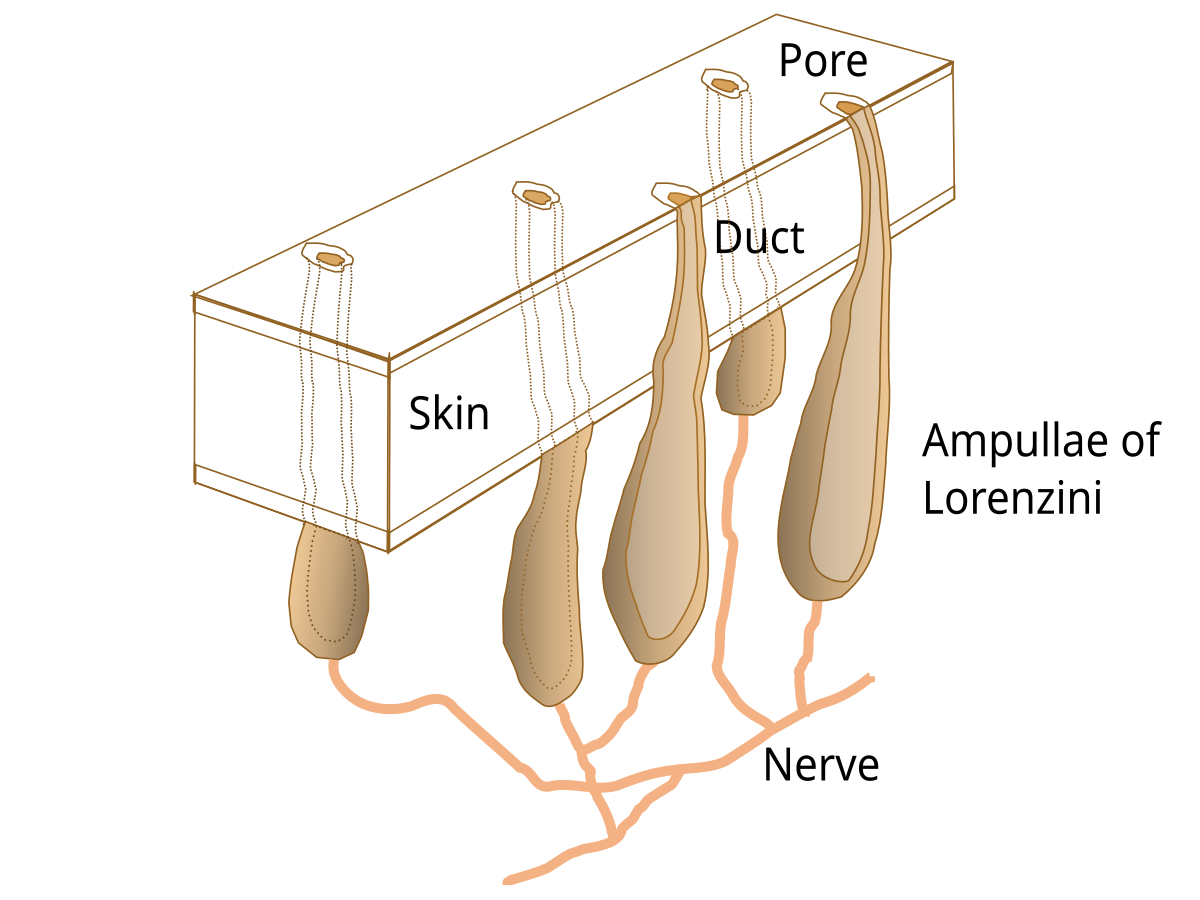
In 1678, Stefano Lorenzini noticed tiny black pores on the snouts of sharks, but mistakenly thought they were mucus glands. It took nearly 300 years to realize these pores, now called Ampullae of Lorenzini, are actually jelly-filled tubes that conduct electricity.
Diagram illustrating the electrophysiology of an ampulla of Lorenzini, showing how it detects an electric field. Chiswick Chap, CC BY-SA 4.0, via Wikimedia Commons
By the 1960s, experiments proved sharks would ignore real fish entirely to viciously bite an electrode mimicking a living creature's pulse.
Weaponized electricity
Electroreception is almost exclusively aquatic because water conducts electricity far better than air. Some species take the ability a step further with electrogenesis, generating their own power.
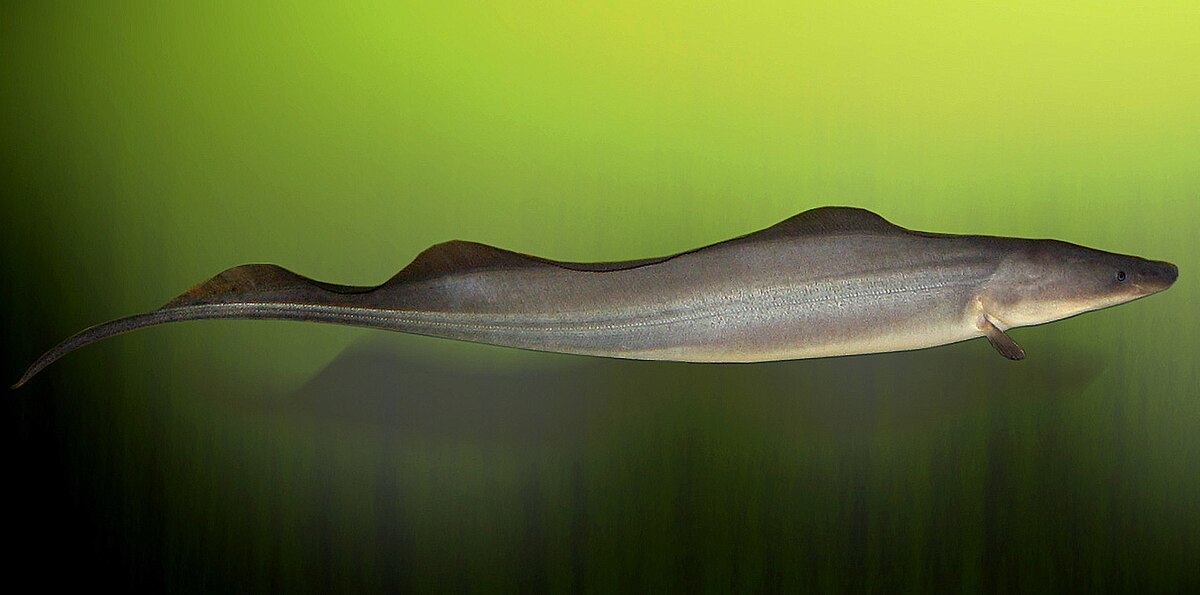
A Gymnarchus niloticus fish, also known as the African knifefish, is shown in profile against a green background. Wiki-Harfus; modified by Wildfeuer, CC BY-SA 3.0, via Wikimedia Commons
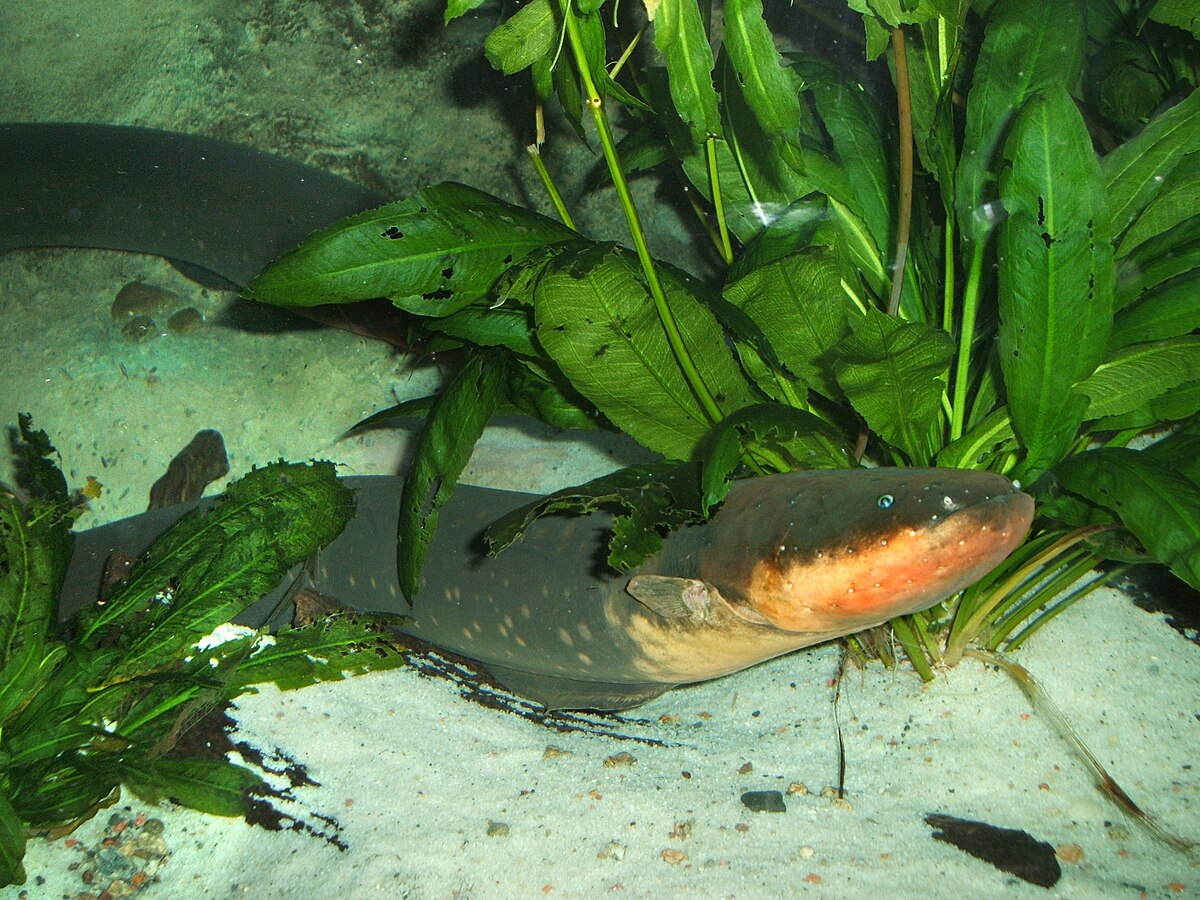
The Electric eel weaponizes this exact biological principle, unleashing up to 600-volt blasts to stun prey.
Passive vs. active electrolocation
In passive electrolocation, predators detect the natural bioelectric fields given off by other organisms. Every animal creates weak electrical noise when its nerves fire, its muscles contract, or its gill membranes pump ions during respiration. Animals like sharks use ampullary receptors, such as the ampullae of Lorenzini, to detect these low frequency electrical signals below 50 Hz.
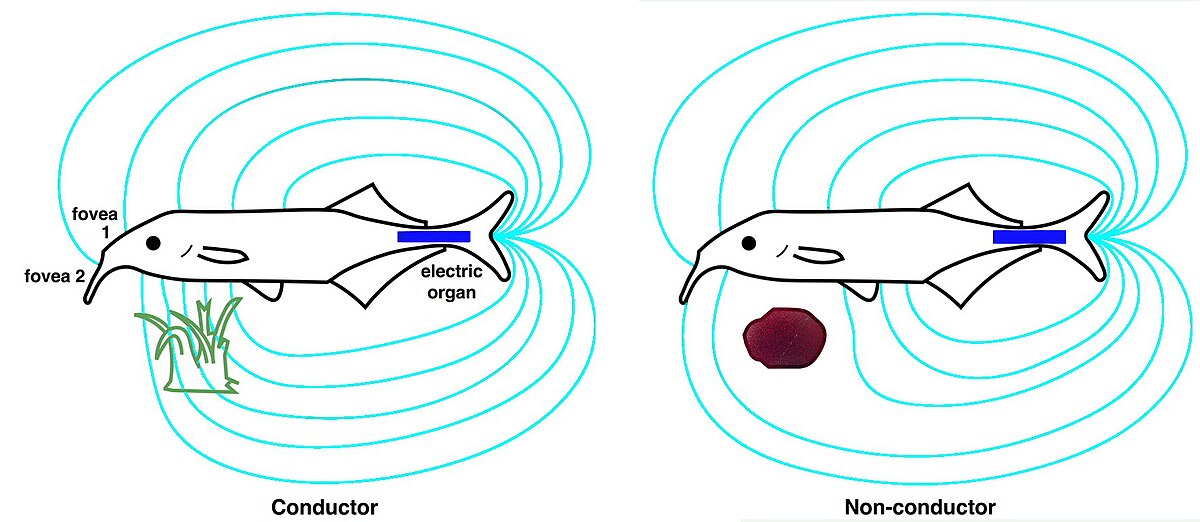
This diagram shows how conducting and non-conducting objects warp the electric field lines surrounding an electric fish. Chiswick Chap, CC BY-SA 4.0, via Wikimedia Commons
Active electrolocation works differently. Instead of waiting for another creature to leak electricity, weakly electric fish generate their own weak field using modified muscle tissue in their tails. They emit voltages generally under one volt, either in brief pulses or continuous waves. When nearby objects distort this field, tuberous electroreceptors across the skin detect differences in resistance and capacitance.
How animals sense electrical signals
Ampullae of Lorenzini feature jelly-filled canals that stretch from skin pores directly to sensory receptor cells. Originally documented in sharks by Stefano Lorenzini in 1678, their actual electrical function went unidentified until R. W. Murray's work in 1960. These ancient structures are found across cartilaginous fishes as well as primitive bony fishes like sturgeons and coelacanths.
A cross-section of the ampullae of Lorenzini showing the skin pore, the jelly canal, and the sensory base innervated by nerves. Chiswick Chap, CC BY-SA 4.0, via Wikimedia Commons
Active electric fish rely on specialized tuberous electroreceptors, such as the knollenorgans and mormyromasts found in African elephantfishes. These organs use loose plugs of epithelial cells to couple sensory cells to the water, allowing them to sense high frequency stimuli between 20 and 20,000 Hz within about one body length of the fish.
Test yourself
Why is electroreception predominantly found in aquatic organisms rather than terrestrial ones?
Water is a far better conductor than air. Water readily conducts weak biological electrical fields, whereas air acts as an insulator that rapidly dissipates such tiny currents.
The Ampullae of Lorenzini primarily function as mucus-secreting organs.
False. Though initially misidentified as mucus glands, the Ampullae of Lorenzini are actually specialized sensory receptors that conduct electricity to detect the minute bioelectric fields of prey.
Play the lesson in edgi and the card is yours. It lands on your Map next to the ideas it connects to, and turns from matte to foil to gold as you learn more around it.
Yes. While most bony fish lost the trait, electroreceptors independently evolved in monotremes like the platypus and echidna, as well as the Guiana dolphin.
How does an electric eel hunt using electricity?
The electric eel uses active electroreception by emitting a weak electric field to locate targets. Once it detects prey, it discharges its electric organs with high-voltage blasts up to 600 volts to stun or kill the target.
Why do weakly electric fish swim with rigid bodies?
Fish like the African knifefish keep their spines straight and propel themselves using undulating fins. This rigid posture stabilizes their self-generated electric field, allowing them to swim backward and forward with equal precision to inspect prey.