Dunning-Kruger EffectWhy the unskilled overestimate
The Dunning-Kruger effect is a cognitive bias where people with low ability in a specific area overestimate their competence. People who lack a skill often lack the very knowledge needed to judge their own performance. At the same time, top performers often underestimate their relative skill by assuming others find the task just as easy.
By the edgi team We find the most surprising true thing about an idea and build a 60-second lesson around it.
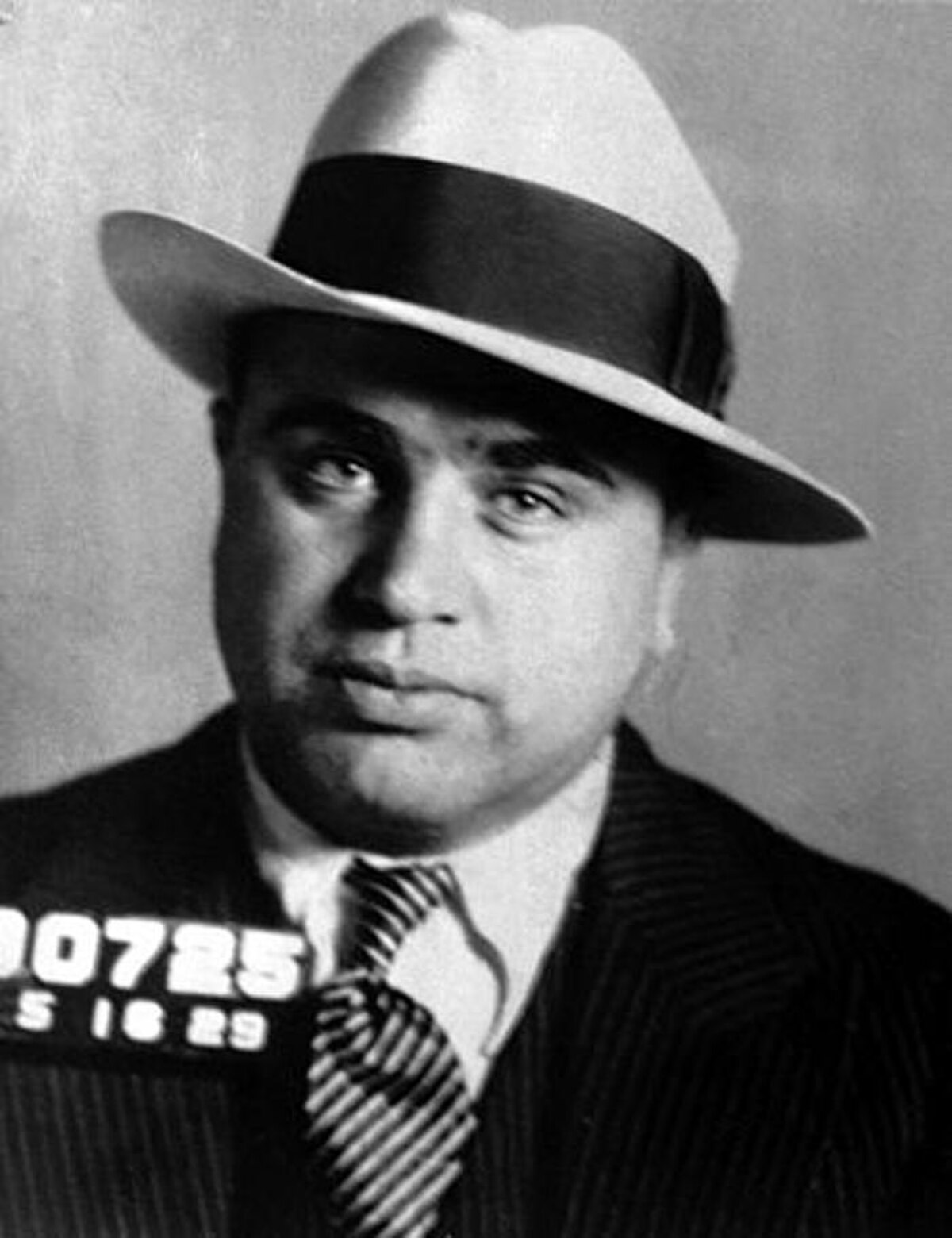
In 1995, McArthur Wheeler robbed two banks in broad daylight without wearing a mask. He had smeared lemon juice on his face, convinced that because lemon juice works as invisible ink on paper, it would render his face invisible to security cameras.
When police showed him the footage, he was genuinely shocked. He muttered, "But I wore the juice."
Mugshot of Al Capone, taken by the Bureau of Investigation in 1929, showing him wearing a light-colored fedora and a striped tie. Pennsylvania Department of Corrections / FBI, Public domain, via Wikimedia Commons
The mechanism
Psychologists David Dunning and Justin Kruger read about Wheeler and decided to study why people are so blind to their own incompetence. They found that the same metacognition, the ability to think about your own thinking, needed to be good at a task is also required to realize you are bad at it.
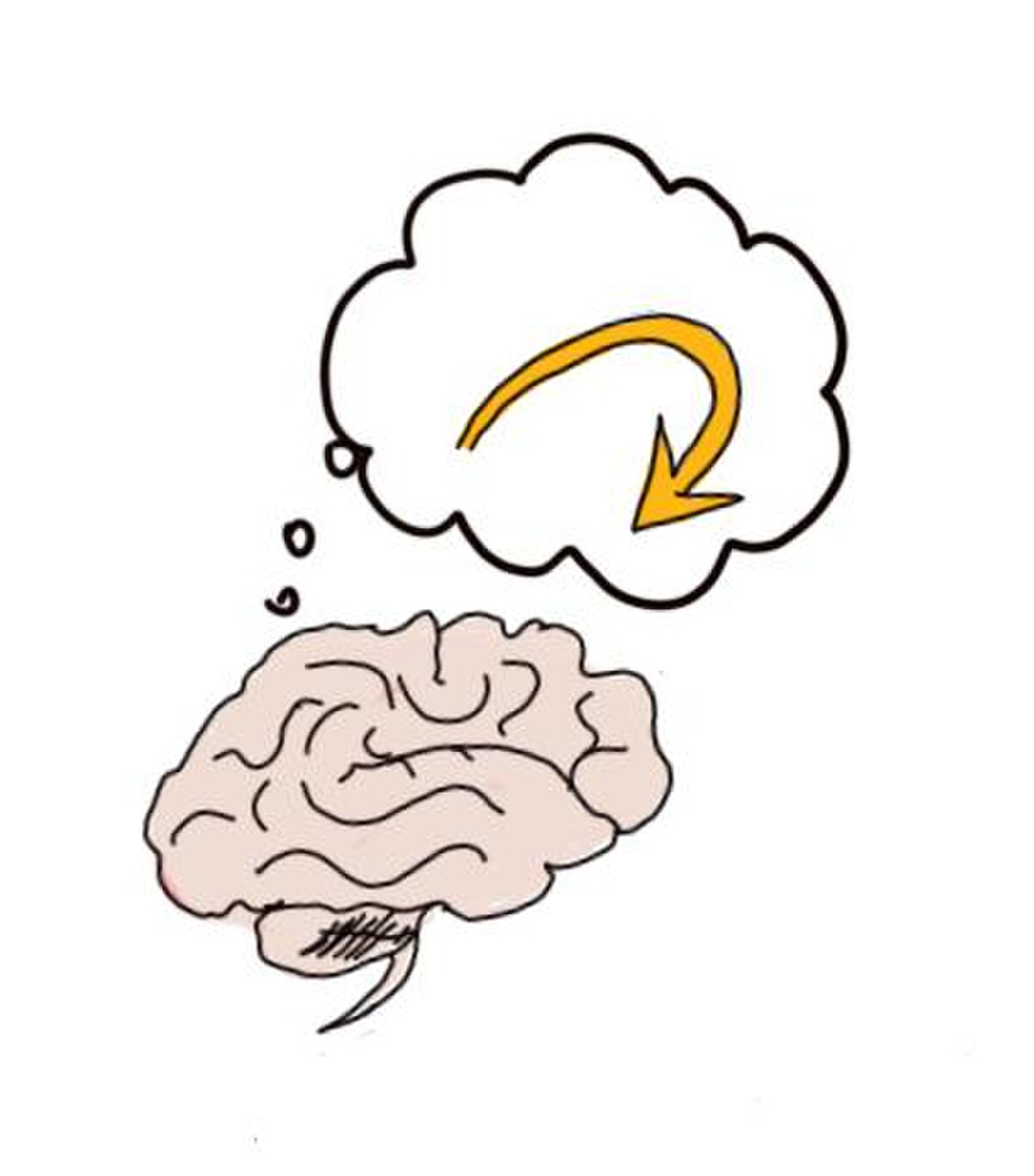
An illustration depicting metacognition, with a stylized brain and a thought bubble containing a curved arrow pointing back towards the brain. Giulia Forsythe, CC0, via Wikimedia Commons
If you lack the skill to perform a task, you also lack the skill to judge your performance, leading to a massive overestimation of your abilities.
The expert paradox
The effect cuts both ways. Highly competent people often suffer from the opposite problem. Because they find complex tasks easy, they mistakenly assume everyone else does, too.
This leads to the paradox where the most knowledgeable people often doubt their own expertise, a feeling frequently labeled as impostor syndrome.
How does the dual-burden mechanism work?
Low performers face what psychologists call a dual burden: they lack the skill to succeed, and they lack the metacognition, or the ability to think about their own thinking, to realize they failed. Because they cannot tell competence from incompetence, they evaluate their errors as successes.
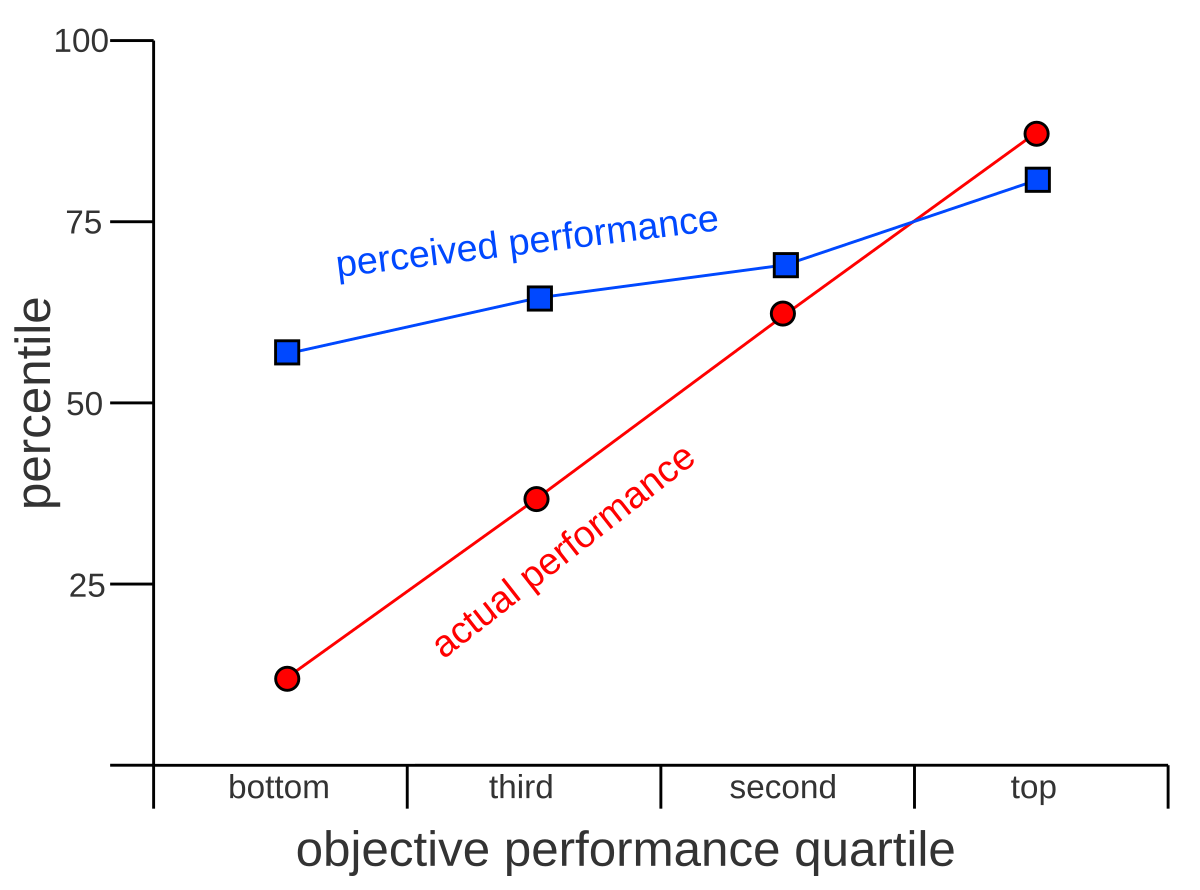
Notice how perceived performance stays relatively high even as actual performance drops across the lowest quartiles. Phlsph7, CC BY-SA 4.0, via Wikimedia Commons
The effect is task-specific rather than a general measure of intelligence. A skilled surgeon can experience the effect when trying to fix a car engine or manage an investment portfolio. Low performers still rate their abilities lower than high performers do, but their subjective estimates sit far higher than their actual scores.
How do researchers test the effect?
Studies measure the bias by having participants complete a task, such as a quiz on grammar, logic, or driving, and estimate their performance without feedback.
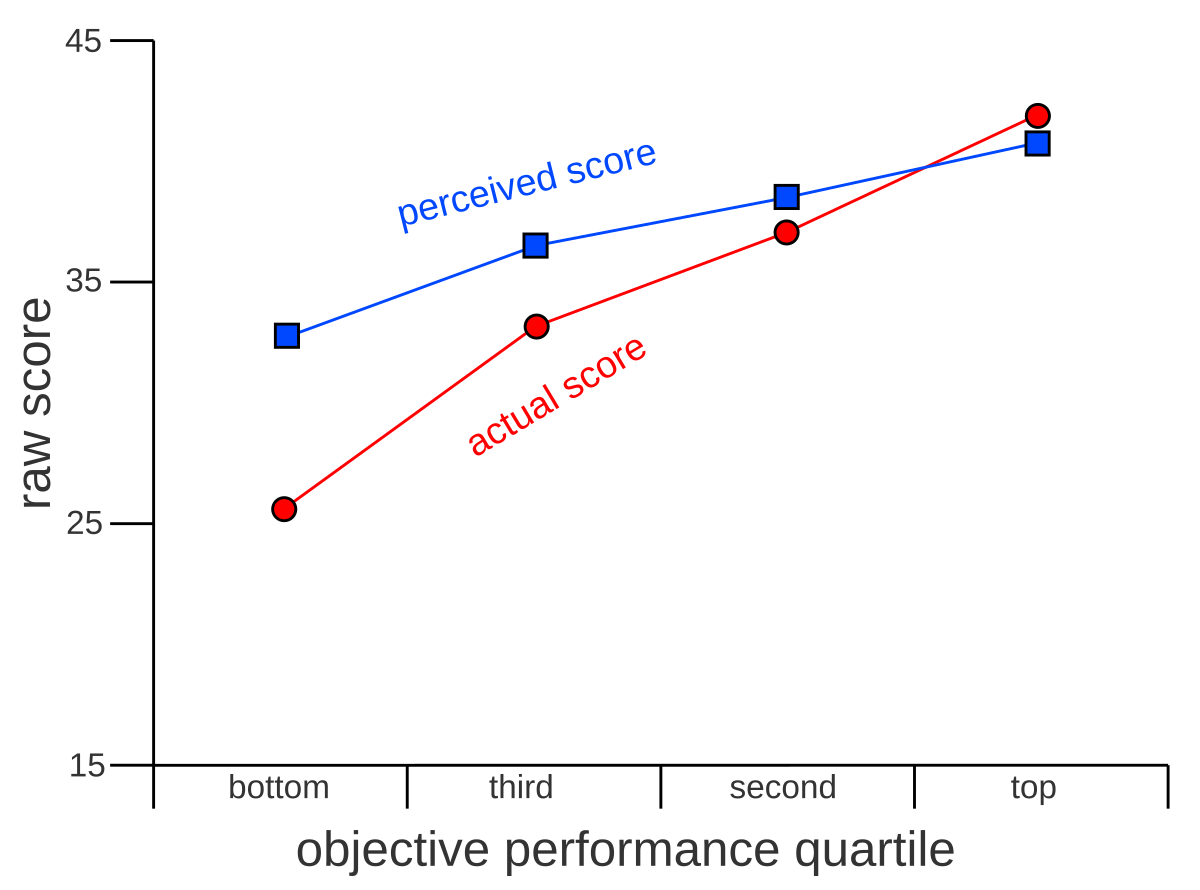
Compare the gap between perceived scores and actual scores to see the overestimation among lower-performing groups. Phlsph7, CC BY-SA 4.0, via Wikimedia Commons
Researchers evaluate these estimates in two ways: absolute terms, such as raw test scores, and relative terms, such as estimating what percentage of peers they outperformed. The bias appears in fields ranging from aviation and medicine to school examinations and spatial memory.
Why do experts underestimate their relative performance?
High performers make a different evaluation error. They assess their raw performance accurately but fall prey to the false-consensus effect, assuming that what comes easily to them comes easily to everyone else.
This mistaken assumption causes experts to assume their peers performed equally well, driving down their relative self-ranking.
Test yourself
Does the Dunning-Kruger effect stem from an inability to perform a task or an inability to evaluate performance?
Inability to evaluate performance. The root cause is metacognitive: the mental skills needed to judge an outcome are the exact same ones needed to achieve it.
Why do highly competent individuals often experience the Dunning-Kruger effect as self-doubt?
They assume difficult tasks are easy for others. Experts mistakenly project their own ease with complex problems onto the general population, leading them to undervalue their own relative expertise.
What makes someone genuinely blind to their own incompetence?
Lacking the skill to judge performance. You need the exact same cognitive skills to perform a task as you do to evaluate how poorly you are doing it.
Play the lesson in edgi and the card is yours. It lands on your Map next to the ideas it connects to, and turns from matte to foil to gold as you learn more around it.
Does the Dunning-Kruger effect mean low-intelligence people are always confident?
No, it does not describe general intelligence. It applies specifically to a person's skill level in a particular task, and low performers still report lower overall confidence than experts.
What real-world problems does the effect cause?
Flawed self-assessment can lead low performers into dangerous situations or unsuited careers. It can also prevent people from seeking training to fix their shortcomings.
Are there competing explanations for the effect?
Yes, some researchers propose that the pattern stems from statistical artifacts combined with a general tendency to believe one is above average. Others attribute it to overly positive prior beliefs or the difficulty of evaluating peers with similar low skill levels.