The framing effect is a cognitive bias where people make different choices depending on whether identical options are presented as gains or losses. When choices sound positive, people prefer a guaranteed win, but when the same situation is phrased as a loss, they gamble to avoid it. This reveals that human judgment is guided by presentation rather than pure logic.
By the edgi team We find the most surprising true thing about an idea and build a 60-second lesson around it.
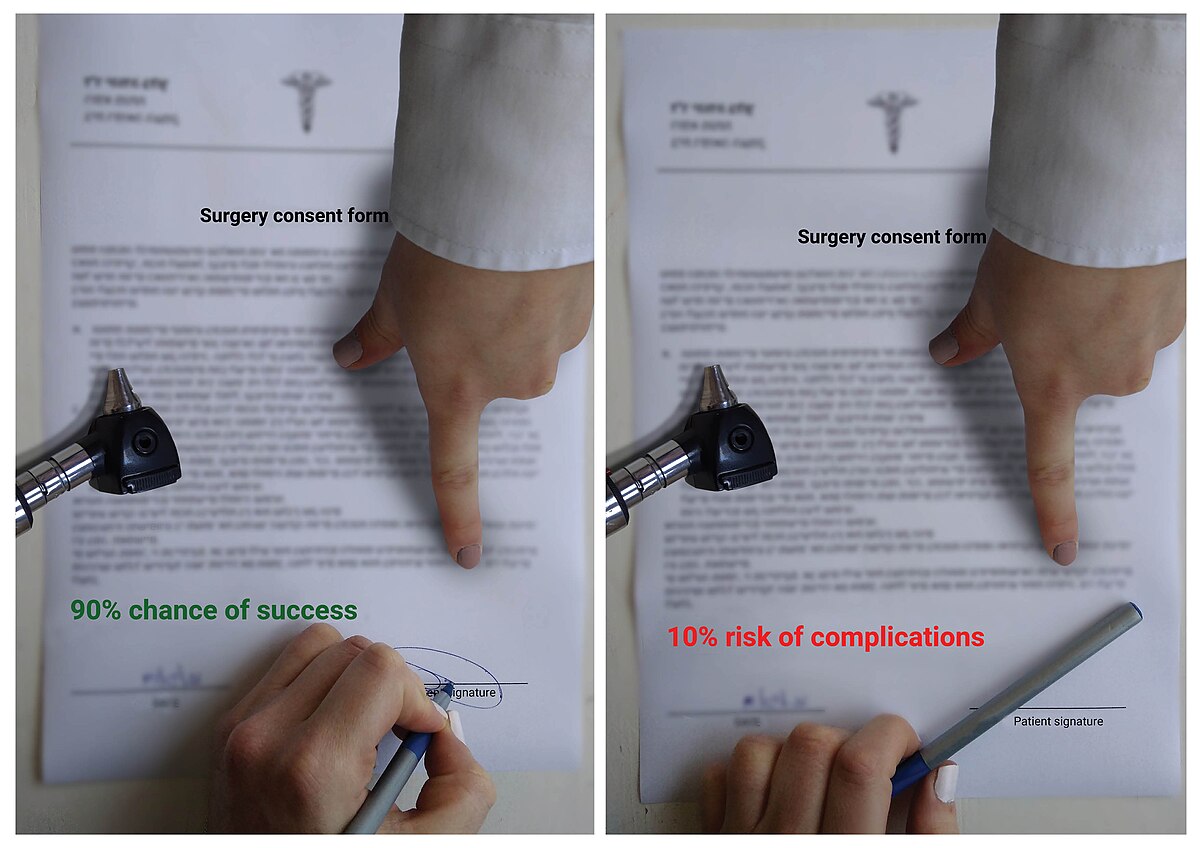
Tell people a surgery has a 90 percent survival rate, and they largely agree to the procedure. Tell them it has a 10 percent mortality rate, and they recoil.
An illustration of the framing effect, showing two hands pointing to a "Surgery consent form" with different success and risk framings. Mushki Brichta, CC BY-SA 4.0, via Wikimedia Commons
It is the exact same math, but the emotional frame triggers two completely different reactions in your brain.
The 1981 experiment
Psychologists Amos Tversky and Daniel Kahneman once tested this with a hypothetical disease threatening 600 people. When offered a choice that saved 200 lives for sure, people chose the safe bet.
Portrait of Daniel Kahneman, a psychologist and economist, wearing glasses and a suit, known for his work on prospect theory. nrkbeta, CC BY-SA 2.0, via Wikimedia Commons
But when the math was reframed as '400 people dying,' the majority suddenly flipped and chose the risky gamble to avoid the certain loss.
The marketing trap
This is why '90 percent lean' ground beef sells better than '10 percent fat' beef. We are driven by loss aversion. We hate the sting of a guaranteed loss so much that we will take irrational risks just to avoid it.
The framing effect turns us into predictable, emotional actors, not the logical ones we think we are.
How Prospect Theory explains the shift
Economists once relied on the rational actor model, which assumed humans have stable preferences, full information, and unbiased calculation skills. Psychologists Amos Kahneman and Amos Tversky challenged this with prospect theory in 1981, showing that real choices depend heavily on how options are framed.
Prospect theory establishes that the pain of a loss is psychologically more significant than the pleasure of an equivalent gain. When choices are framed positively as gains, such as saving lives or making money, people favor a sure gain over a risky bet. When choices are framed negatively as losses, people switch their behavior and pick an uncertain gamble to avoid an inevitable loss.
Intuition and dual systems of thought
In his 2011 book Thinking, Fast and Slow, Kahneman explained decision-making through two systems. One system is automatic, intuitive, and emotional, operating quickly with little effort. The other system is deliberate, logical, and requires conscious effort.
People fall prey to framing effects when relying on the intuitive system. Because this fast mode of thinking reacts to contextual cues and surface-level presentations, it accepts the frame provided rather than converting the math into an objective comparison.
Valence framing and opinion polls
Framing alters more than economic gambles; it actively shapes political attitudes. Negative statements like opposing a policy generate stronger resistance and certainty than positive statements like supporting a policy, even when both describe the same outcome.
Organizations exploit this through spin in political opinion polls, phrasing questions specifically to encourage responses that benefit the sponsor. This practice has raised concerns about the credibility of polling. Providing ample credible information reduces or eliminates the framing effect.
Test yourself
How does the framing effect influence decision-making under uncertainty?
It triggers risk-seeking when framed as a loss.. The framing effect shifts our appetite for risk depending on whether an option highlights gains or losses. We seek certainty for gains but gamble to avoid guaranteed losses.
The framing effect shows that people make decisions based primarily on objective math.
False. Decisions are driven by how information is framed emotionally, not just the underlying math. We frequently choose differently when the same objective facts are described as gains versus losses.
The attribute framing effect specifically involves the evaluation of a single characteristic of a product or person.
True. Attribute framing is narrow-focused, like judging a medical procedure based solely on its 'survival rate' versus its 'mortality rate.'
Play the lesson in edgi and the card is yours. It lands on your Map next to the ideas it connects to, and turns from matte to foil to gold as you learn more around it.
Kahneman and Tversky showed that people categorize money into separate subjective mental accounts. For instance, people treat losing a ten-dollar bill differently from losing a ten-dollar movie ticket, even though the financial loss is identical.
How do humans misjudge probability?
People do not evaluate probability logically. They tend to overestimate the likelihood of rare events like winning the lottery while underestimating events with moderate to high probability.
Can the framing effect be eliminated?
Yes. The framing effect is significantly reduced or eliminated when people receive ample credible information about the options.