Lipoproteins are microscopic carrier particles made of fats and proteins that transport greasy molecules through watery fluids like blood plasma. Because fats and cholesterol cannot dissolve in water on their own, the body wraps them in a soluble shell. Without these carriers, essential fats could not reach the cells that need them for energy and structural membranes.
By the edgi team We find the most surprising true thing about an idea and build a 60-second lesson around it.
Oil and water famously don't mix, creating a lethal problem for your body: fat needs to travel through watery blood without forming a solid plug. To solve this, your body builds microscopic vessels called lipoproteins that encapsulate greasy triglycerides and cholesterol inside a water-friendly shell.
These tiny spheres act as a biological delivery service, dropping off fuel and building materials to cells all over your body.
Good and bad densities
In the 1950s, John Gofman used an ultracentrifuge to spin blood at massive speeds, discovering that these particles come in different densities. He realized that high-density lipoprotein acted like a vacuum cleaner, picking up excess fat, while lower-density cousins were prone to leaking.
If these delivery vessels crash or spill their cargo, they trigger atherosclerosis, where fat hardens into the plaque that causes heart attacks.
How lipoprotein particles are built
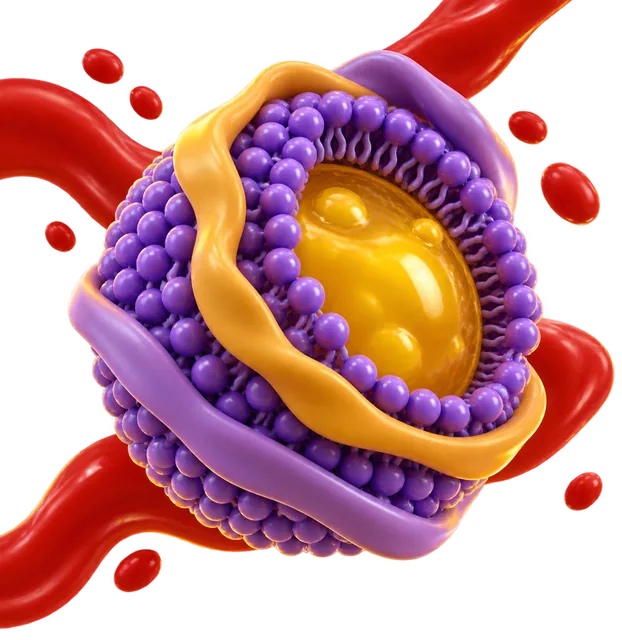
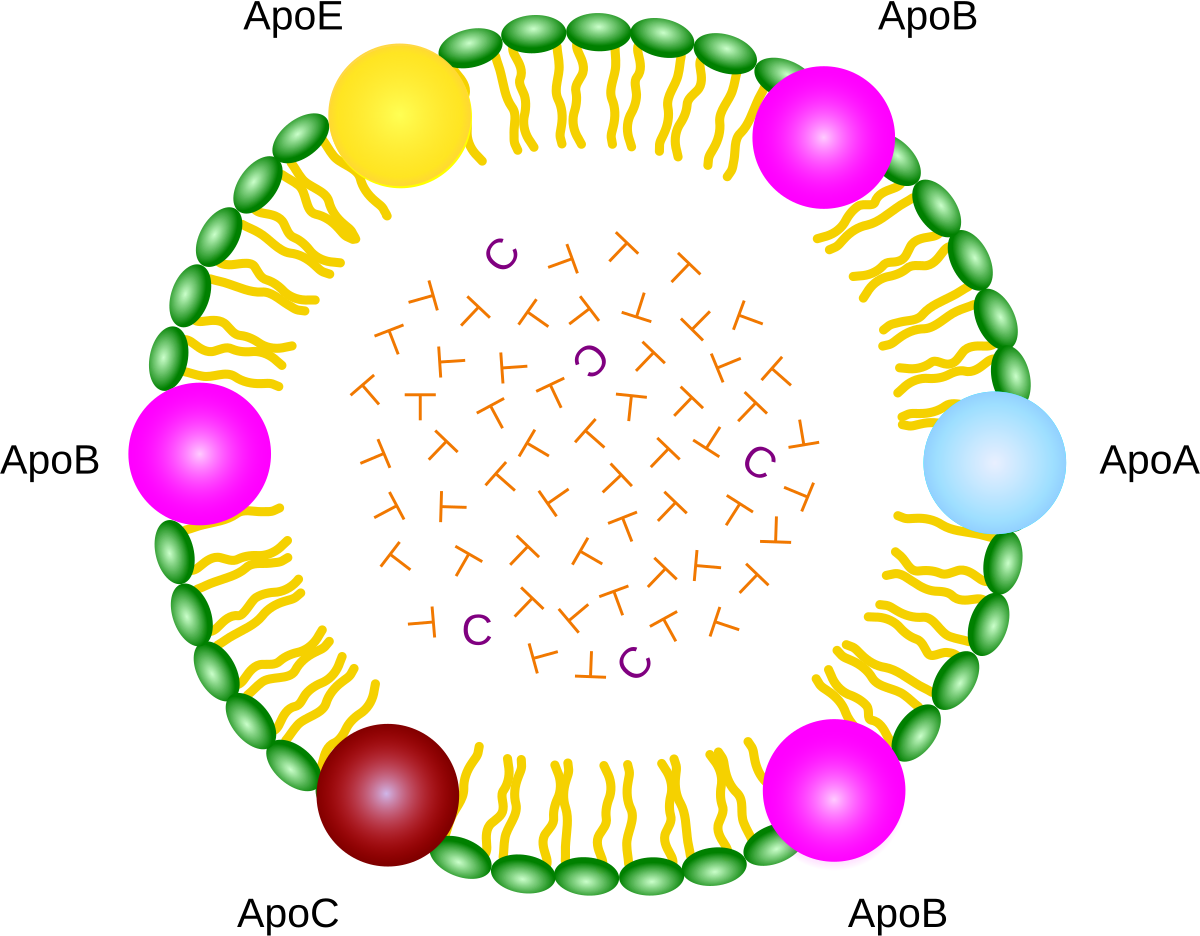
A lipoprotein functions like a sealed container designed specifically to travel through water. At its center lies a hydrophobic core packed with non-polar lipids, primarily triglycerides and cholesteryl esters. This oily cargo is shielded from the surrounding bloodstream by a single-layer outer shell.
This cross-section shows how phospholipids and surface apolipoproteins encase the inner core of triglycerides and cholesteryl esters. Xvazquez, CC BY-SA 3.0, via Wikimedia Commons
The outer shell consists of phospholipids, free cholesterol, and specialized proteins called apolipoproteins. Phospholipids align with their water-soluble portions pointing outward into the blood and their fat-soluble tails pointing inward toward the lipid core. The embedded apolipoproteins stabilize the entire structure and serve as biological address tags, directing the particle to bind with specific enzymes and cell receptors.
The five main classes of lipoproteins
Blood plasma contains five main classes of lipoproteins, categorized by size, lipid composition, and apolipoprotein content. Listed in order from largest to smallest, they are chylomicrons, very-low-density lipoproteins (VLDL), intermediate-density lipoproteins (IDL), low-density lipoproteins (LDL), and high-density lipoproteins (HDL).
Chylomicrons carry dietary fats absorbed from the intestines, while other classes manage lipids synthesized or repackaged inside the liver. Subgroups of these circulating particles can drive atherosclerosis if they break down or deliver lipids improperly, forming hard plaques inside blood vessels.
How the body processes dietary fat
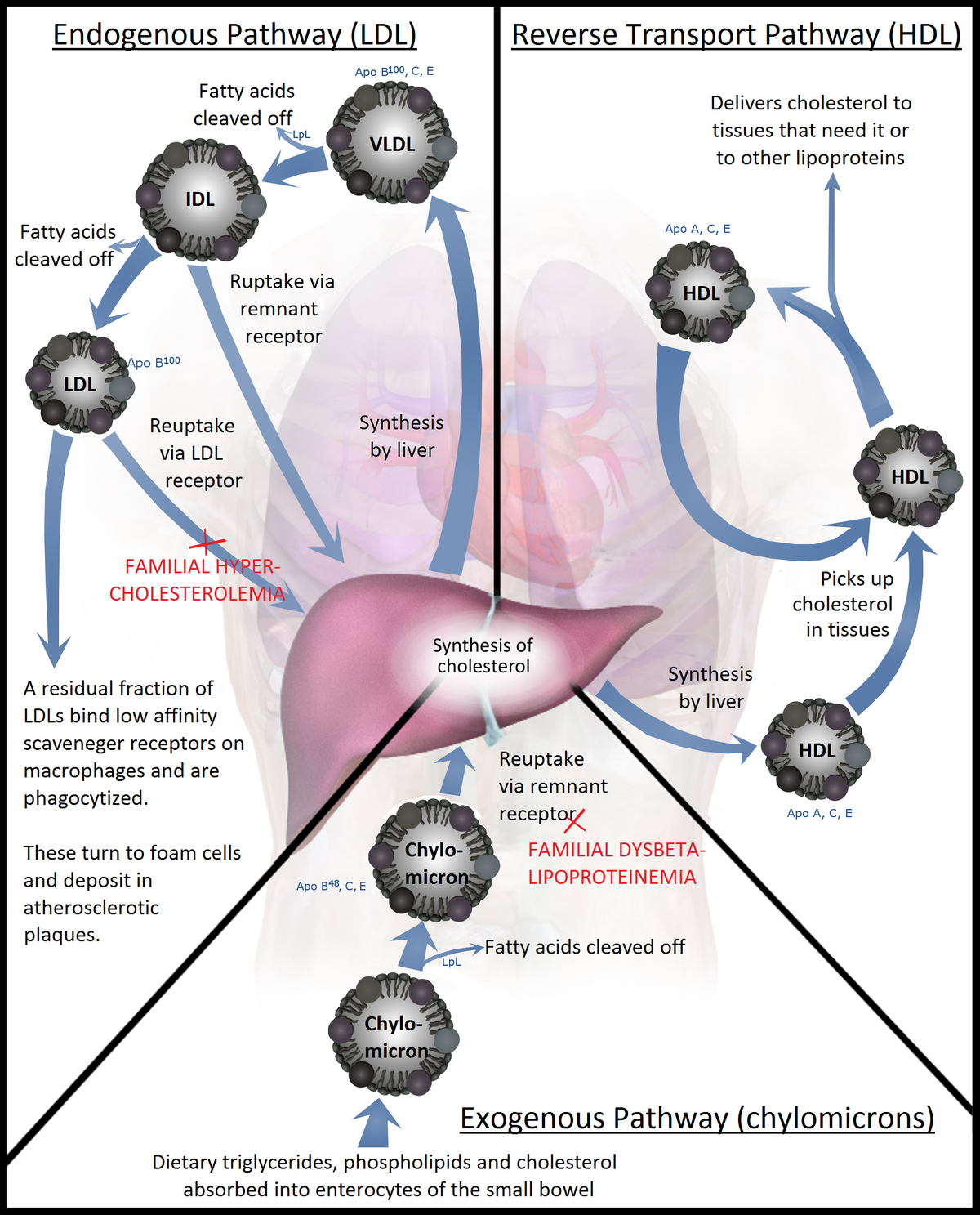
Dietary fat handling follows the exogenous pathway. After digestion in the intestines, cells called enterocytes reassemble absorbed fatty acids into triglycerides, combine them with apolipoprotein B-48, and release nascent chylomicrons into lymphatic vessels called lacteals.
The flowchart tracks how lipid particles move between the digestive system, bloodstream, tissues, and liver. Npatchett, CC BY-SA 3.0, via Wikimedia Commons
These particles bypass the liver and enter the bloodstream through the thoracic duct. Once in circulation, nascent chylomicrons receive apolipoproteins C-II and E from circulating HDL particles. Apolipoprotein C-II activates lipoprotein lipase on blood vessel walls, which strips triglycerides out of the chylomicron to feed muscle and fat tissues. The leftover chylomicron remnants travel to the liver, where apolipoprotein E binds to liver receptors to trigger their absorption and final breakdown.
Play the lesson in edgi and the card is yours. It lands on your Map next to the ideas it connects to, and turns from matte to foil to gold as you learn more around it.
Apolipoproteins and lipoprotein particles are synthesized and secreted primarily by liver cells (hepatocytes) and small intestine cells (enterocytes). Fat storage cells, known as adipocytes, store triglycerides but do not produce lipoproteins.
Why do cells throughout the body need the fats delivered by lipoproteins?
All cells rely on fats and cholesterol as structural building blocks to assemble cell membranes. These membranes allow cells to control their internal water content, regulate internal dissolved elements, and organize their enzymatic systems.
Are all lipoproteins found floating in the bloodstream?
Most discussions refer to plasma lipoprotein particles in blood and extracellular fluids, but some bacterial proteins embedded in cell membranes are also called transmembrane lipoproteins. These membrane-bound proteins are insoluble in water and require detergents to separate from cell membranes.