Alcohol by volumeWhy mixing ethanol shrinks liquids
Alcohol by volume is the share of a beverage that is pure ethanol, calculated by dividing the volume of separated ethanol by the total volume of the liquid at 20 °C. It serves as the standard global measurement for how strong an alcoholic drink is. Because water and ethanol shrink slightly when mixed together, making a drink requires adding enough water to reach an exact total volume rather than simply adding two separate volumes together.
By the edgi team We find the most surprising true thing about an idea and build a 60-second lesson around it.
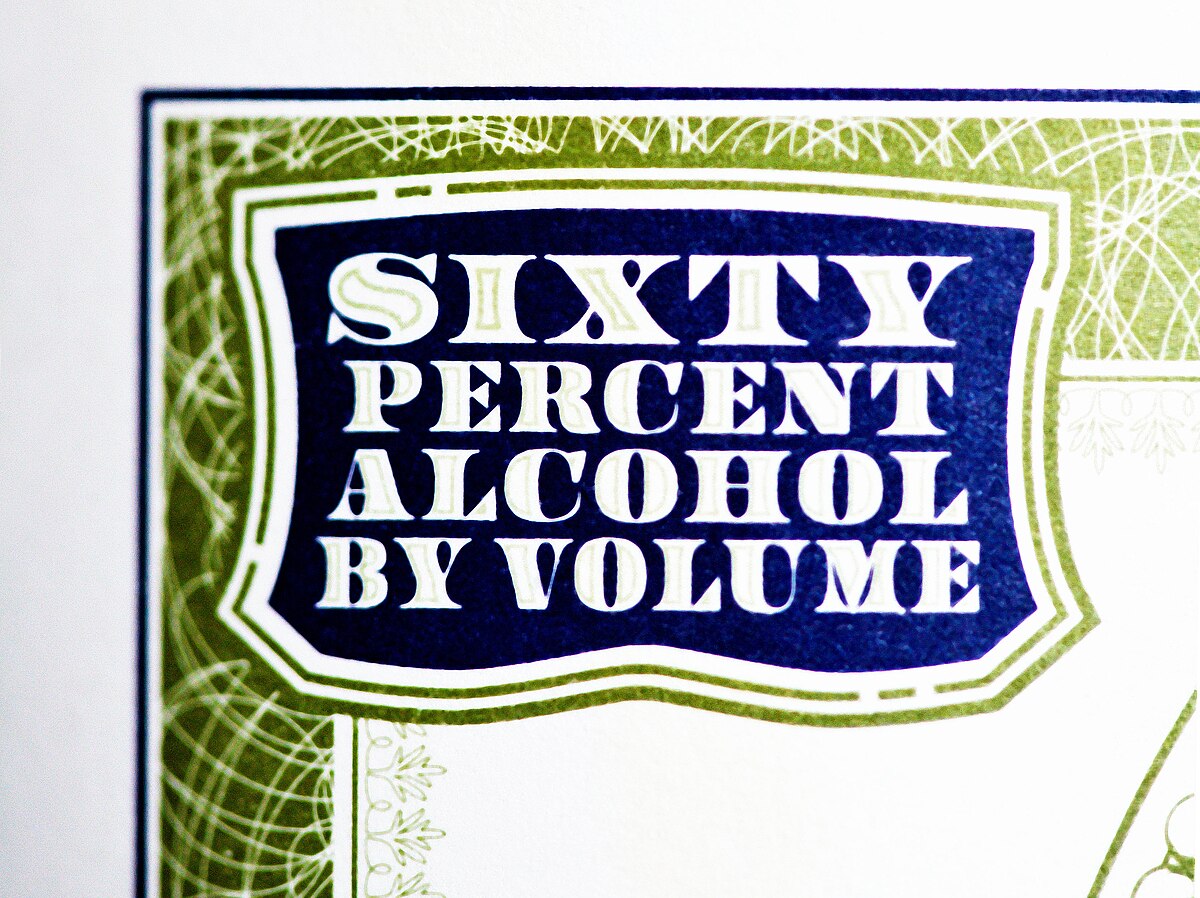
Alcohol by volume is the share of a drink that is ethanol. Out of every 100 milliliters, beer has about 5, wine about 13, and whisky and vodka about 40. Spirits in America carry a second number, and proof is the percentage doubled: 80 proof is 40 percent. The word comes from a tax test that wet gunpowder with spirit to see if it still lit.
A close-up of a label on a bottle of absinthe, prominently displaying the text "SIXTY PERCENT ALCOHOL BY VOLUME" in a decorative blue and green design. Lynnea Kleinschmidt, Public domain, via Wikimedia Commons
Percentage alone is not a dose. A 12 ounce beer, a 5 ounce glass of wine and a 1.5 ounce shot each carry about 14 grams of alcohol, which in the United States is one standard drink. A 16 ounce craft beer at 8 percent counts as closer to two drinks than one.
Why the numbers stop where they do
Beer commonly lands near 5 percent and wine near 14. Fermentation has a ceiling, but starting sugar also helps set where each drink stops. Yeast makes alcohol, and alcohol eventually poisons yeast. If a sugary brew reaches the yeast's limit, fermentation can stop with sugar left.
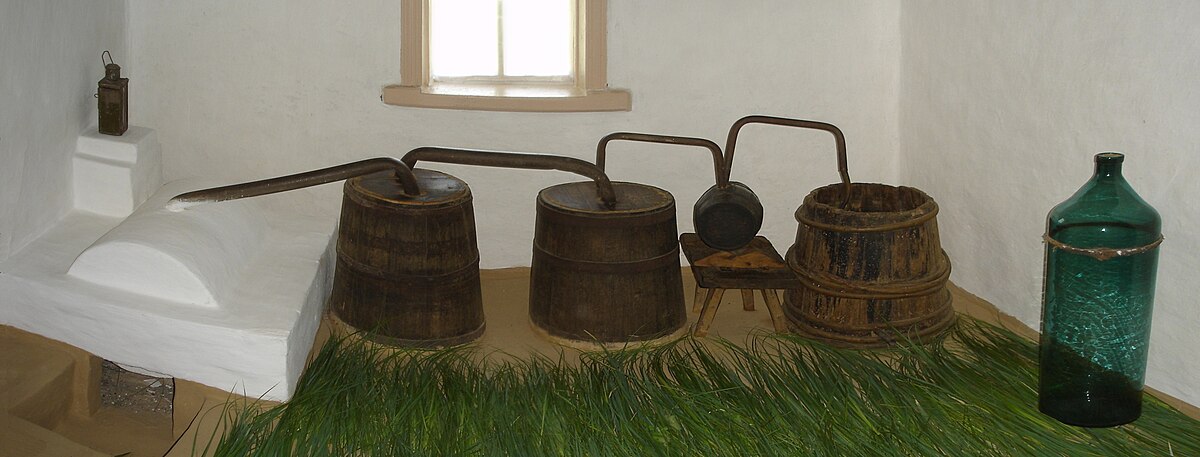
Beer stops earlier because brewers start with far less sugar than grapes carry. Wine starts with enough sugar to reach a much higher alcohol level. To make a spirit stronger, producers use distillation. It boils alcohol off ahead of water and collects it.
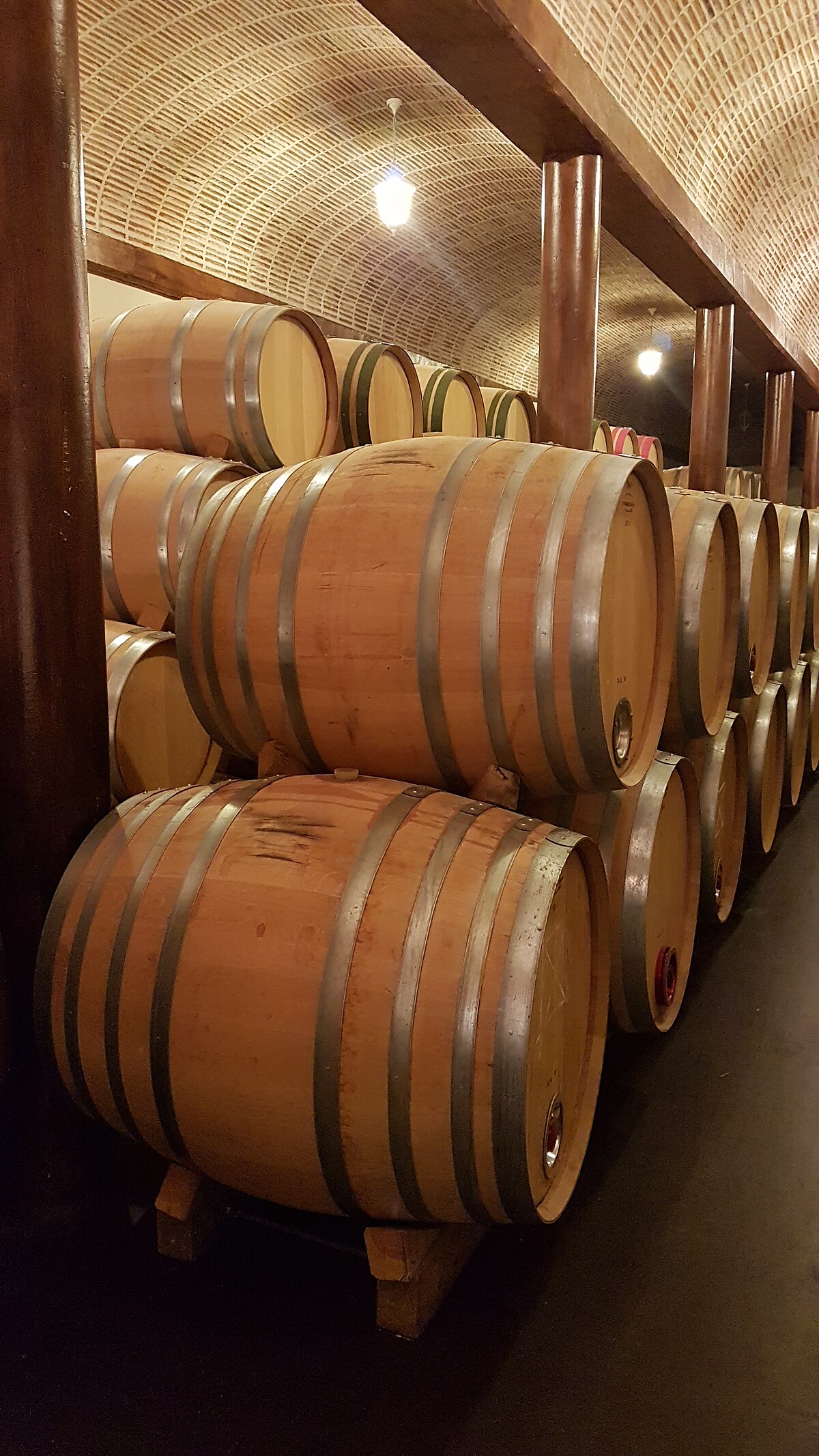
An old Ukrainian vodka still displayed indoors, featuring three wooden barrels connected by metal pipes, suggesting a traditional distillation process. Arne Hückelheim, CC BY-SA 3.0, via Wikimedia Commons
Alcohol by volume gives you a rough hint, not an origin story. A high number often involves distillation, but the number alone cannot tell you how a drink was made.
What the number feels like
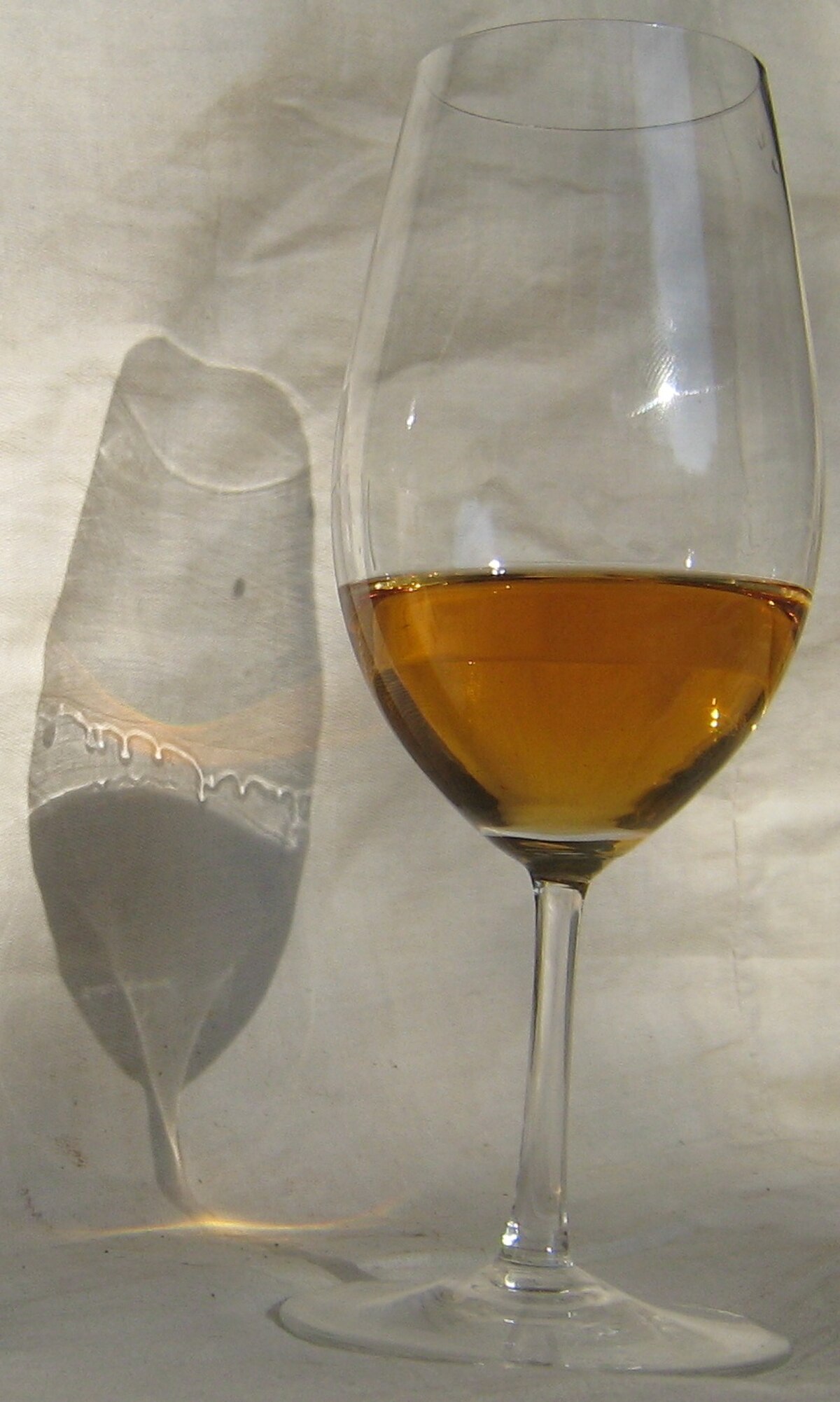
Alcohol content gives you a useful clue to texture before you drink. Ethanol mixed with water is more viscous than either liquid alone, which can add weight in the mouth, but alcohol is only one part of body. Alcohol also leaves a visible trace. It evaporates faster than water from the film on the glass, changing the surface tension and pulling wine up the wall before it runs back down in streaks.
A glass of amber-colored wine with a 13.5% alcohol content is shown, casting a shadow on a textured white background. FlagSteward, CC BY-SA 3.0, via Wikimedia Commons
James Thomson explained those streaks in 1855. Modern physics calls the pattern the Marangoni effect. Thick slow legs are a real reading of alcohol, never a reading of quality.
How water and ethanol shrink when mixed
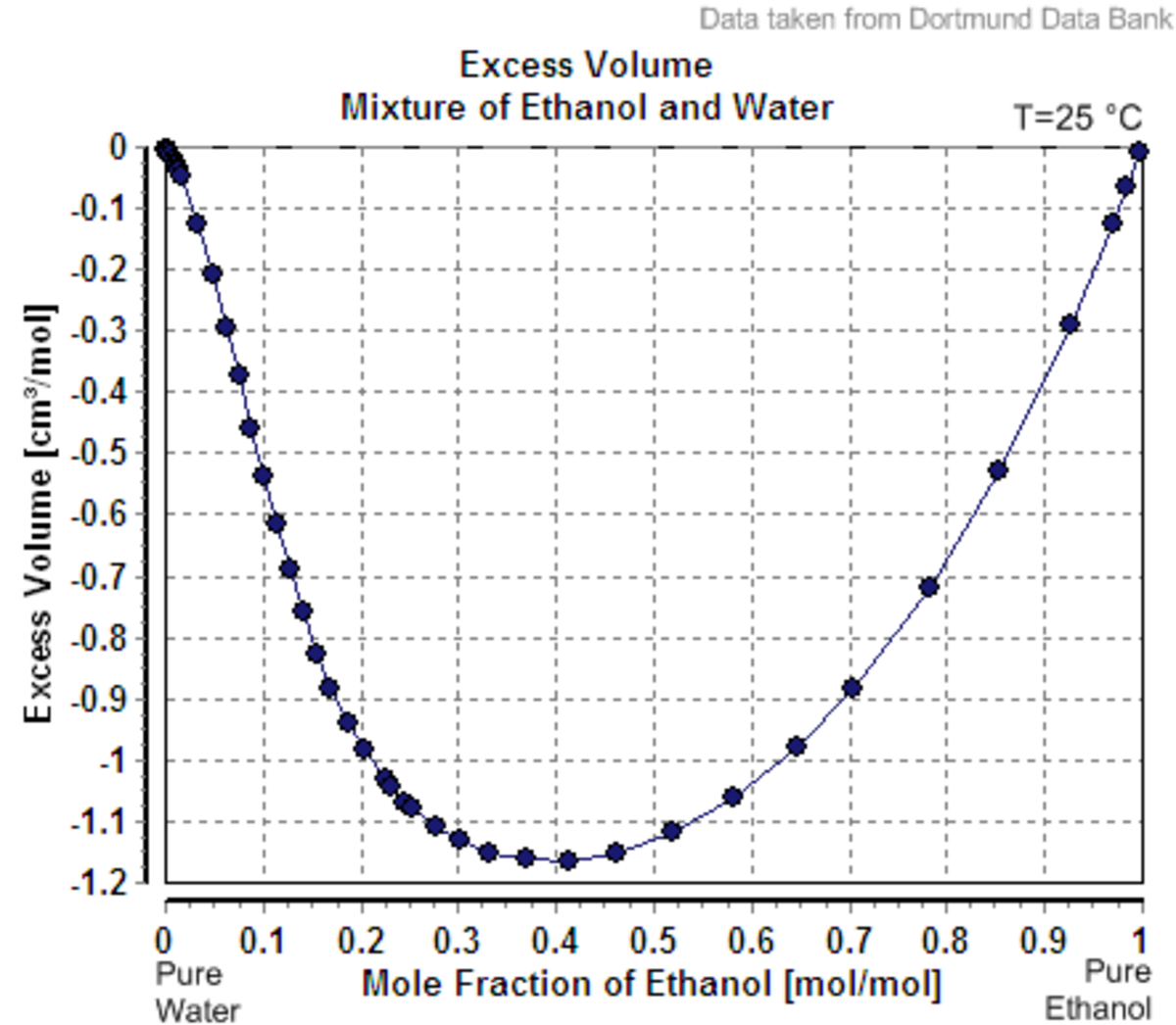
Mixing 50 milliliters of pure ethanol with 50 milliliters of pure water does not yield 100 milliliters of liquid. The total volume decreases because water and ethanol are both polar solvents. Water molecules are attracted to the hydroxyl group on ethanol, which packs the molecules closer together than they sit on their own.
The curve tracks how total volume changes across different concentrations when ethanol and water are combined. Wilfried Cordes, CC BY-SA 3.0, via Wikimedia Commons
Because of this volume change, known as partial molar volume, alcohol by volume is defined specifically: to make 100 milliliters of a 50 percent ABV solution, a producer adds enough water to 50 milliliters of ethanol until the combined liquid reaches exactly 100 milliliters. Simply combining equal separate parts would yield less than 100 milliliters and produce a higher alcohol concentration.
How brewers calculate ABV during fermentation
Yeast creates ethanol by consuming sugar and turning each mole of sugar into two moles of alcohol. Because sugar makes water denser while ethanol makes water lighter, the overall density of the fermenting liquid steadily drops as alcohol levels rise.
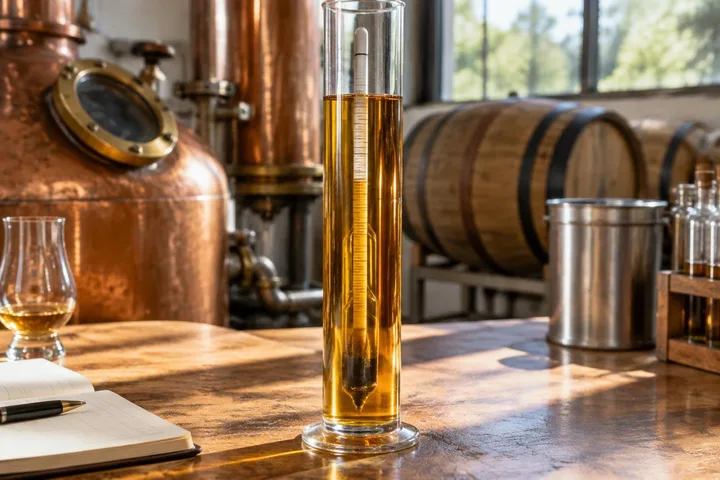
Brewers and winemakers track this drop using a hydrometer, which measures specific gravity: the density of the solution compared to pure water. By comparing specific gravity before fermentation to the specific gravity at the end, producers can calculate exactly how much sugar was converted and determine the finished ABV.
Biological and legal ABV limits
Beer yeasts generally stop working between 8 and 12 percent ABV, while wine yeasts survive up to 14 to 18 percent, with specialized strains reaching 20 percent. Beyond that threshold, alcohol poisons the yeast, meaning any drink with a higher concentration requires distillation.
Law also mandates precise thresholds for beverage labels. In the United States, Canada, the European Union, and the United Kingdom, bottled whisky must contain at least 40 percent ABV. On the low end, non-alcoholic beers generally sit at 0.05 percent ABV, and drinks below 0.5 percent ABV are permitted in countries like Iran where standard alcoholic drinks are banned.
Test yourself
A sugary brew reaches its yeast's limit. What can stop it fermenting?
Alcohol eventually poisons the yeast. If a sugary brew reaches the yeast's limit, alcohol can poison the yeast and stop fermentation with sugar left.
Applejack can be made by freezing cider and removing ice. Why does its ABV rise?
Removing ice takes out mostly water. Removing water-rich ice leaves the remaining cider more concentrated. This is freeze concentration, not distillation, so ABV alone does not reveal the method.
Play the lesson in edgi and the card is yours. It lands on your Map next to the ideas it connects to, and turns from matte to foil to gold as you learn more around it.
Degrees Gay-Lussac is a convention used in countries like France to express alcohol by volume. It measures ethanol concentration at a standard temperature of 15 °C instead of the 20 °C standard used for international ABV.
Can someone get drunk from non-alcoholic beer?
It is virtually impossible for a healthy person to become intoxicated from drinks below 0.5 percent ABV. In a study where volunteers rapidly drank 1.5 liters of 0.4 percent beer in an hour, blood alcohol peaked at just 0.0056 percent, as human metabolism clears the alcohol faster than human kidneys can excrete that much water.