Infinite scrollingHow removing stopping cues keeps you reading
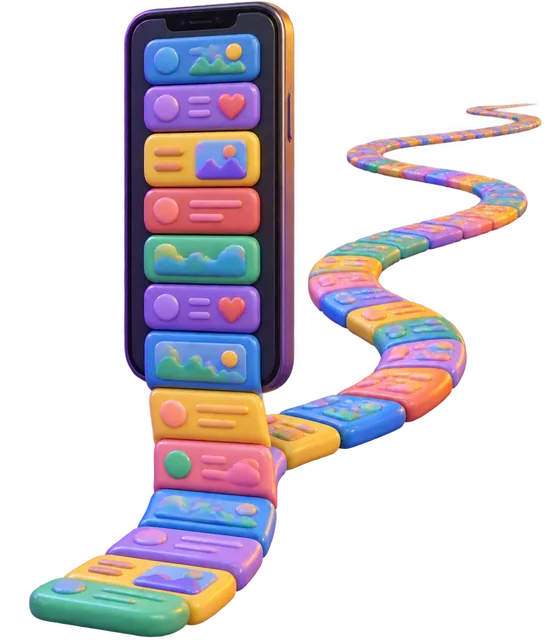
Infinite scrolling is a web design technique where new content automatically loads at the bottom of the screen as you scroll downward, creating the effect of a never-ending page. It replaces pagination, which divides content into numbered pages with separate links. By removing natural stopping points, it makes continuous consumption the default behavior rather than an active choice.
By the edgi team We find the most surprising true thing about an idea and build a 60-second lesson around it.
Search results used to come ten to a page. At the bottom sat a numbered row of links, and clicking one was a small decision: is this worth another page? That row of links is called pagination. Its effect on you was simple: it interrupted, once per page, and made you answer.
An example of a pagination user interface element for a web page is displayed, featuring buttons labeled "Previous", "1", "2", "3", and "Next". Jakub T. Jankiewicz, CC BY-SA 4.0, via Wikimedia Commons
Infinite scrolling deletes the button. The next batch loads before you reach the bottom, so the bottom never arrives and the question never gets put. Nothing here was made more tempting. A decision point was removed, and you carried on doing what you were doing because nothing stopped to ask.
The bowl that refills
Aza Raskin, usually credited with infinite scroll and now apologizing for it, has an analogy. A bowl of soup. Picture a bowl with a tube in the base, quietly refilling while you eat. You would keep going, because you decide you are finished by looking at the bowl.
That has been run, on 464 people. The refilling-bowl group ate more soup, and afterwards guessed they had eaten less than the group who could watch their bowl empty. The feed is the bowl. You were never counting posts. You were waiting for the bottom, and somebody took the bottom away.
The same move with a clock on it
Autoplay is that move with a countdown attached. The credits used to be the cue to get up. Now the next episode starts in five seconds unless you reach for something. Notice what flipped. Stopping used to be the default and continuing took an action. Now continuing is the default and stopping takes one.
The default effect is most of the design. A default is what happens while you are still deciding, and deciding takes longer than five seconds.
How infinite scrolling works
Traditional web design relies on pagination, which separates material into discrete pages that require a click to continue. Infinite scrolling, also known as endless scrolling, replaces those page breaks by continually and dynamically fetching new content as the viewer nears the bottom of the page.
A user continuously scrolling on a mobile interface where new items load dynamically. Japanexperterna.se, CC BY-SA 2.0, via Wikimedia Commons
Variations of this technique exist across major websites. Some platforms use a button to load more material, giving users deliberate control over when new items appear, as seen on Google Search. Others blend continuous feeds with integrated pagination to show users how far down they have moved, which is how the mobile website of Google Shopping presents items.
Who invented infinite scrolling?
The first recorded implementation of infinite scrolling comes from Microsoft rather than social media platforms. The Windows Live Image Search team (later known as Bing) filed a patent application for an infinite-scroll component on 14 February 2006, after developing and testing it internally throughout 2005.
The feature launched to the public on 8 March 2006. Microsoft engineering leader Hugh Williams identified himself alongside Julie Farago and Nick Craswell as the inventors. While designer Aza Raskin claimed in 2019 to have invented the technique, no evidence supports his claim of creating prior art before Microsoft's patent filing.
Test yourself
Does infinite scrolling change behavior primarily by making content more appealing?
No, by removing decision points. Infinite scrolling does not alter the content itself; it changes behavior by removing the natural stopping cues that prompt a user to pause and reflect.
How does the default effect shape user engagement in modern interface design?
By making continuing the passive choice. A default shifts the burden of action so that staying on the path requires no effort, while stopping demands active intervention.
You scrolled for 40 minutes. When did the design act on you?
When you would have hit the bottom. Ranking decides what you see. Infinite scroll decides whether you are ever asked. The 40 minutes came from a question that never got put to you, not from any single post being irresistible.
Play the lesson in edgi and the card is yours. It lands on your Map next to the ideas it connects to, and turns from matte to foil to gold as you learn more around it.
What design problems does infinite scrolling create?
Usability research indicates that infinite scrolling can present accessibility issues for users. The absence of natural stopping cues has also been described as a pathway to social media addiction and smartphone addiction.
What other features launched alongside the first infinite scroll?
When Microsoft tested infinite scrolling in 2005 for Windows Live Image Search, it was paired with now-discontinued features. These included a slider to adjust thumbnail sizes, a scratchpad for saving images, and a hover-over tool for reading image metadata.