Problematic smartphone useWhy it is made of checks
Problematic smartphone use is psychological or behavioral dependence on mobile phones that disrupts daily life, relationships, or physical safety. Researchers use this term to describe compulsive phone habits when there is no formal medical evidence of an addiction. Most excessive use comes from brief, automatic checks throughout the day rather than intentional long sessions.
By the edgi team We find the most surprising true thing about an idea and build a 60-second lesson around it.
What researchers file under problematic smartphone use is not made of long sessions. It is made of checks: unlock, glance at one app, lock, under thirty seconds. Phones instrumented to log every unlock show that is most of the use. And a check is not a decision. A lift arrives, a conversation pauses, and your hand is already moving.
A habit is behavior attached to a cue rather than to a want, and the long session is usually just a check that failed to end.
Why the hand moves
What a check pays out is information, it arrives within a second, and it is not there every time. That fast, unreliable combination builds a habit fastest. The gesture has an origin and it is duller than the story people tell. Loren Brichter built pull-to-refresh into Tweetie 2 in 2009 because his top bar had no room left for a refresh button.
He says he built it that way because the gesture felt more natural than reaching for a corner. People later called it a slot machine handle; his answer was that it makes sense in hindsight.
Move the furniture, not the will
The usual advice is to want the phone less. That fails whether or not this is a behavioral addiction, because it was never a want. It is a cue and a reflex. What moves is the cue. In one randomized study, switching a phone to grayscale cut about 20 minutes a day off screen time. The payout got duller and the reflex got weaker.
Same for charging the phone in another room, or deleting an app and reaching it through a browser. Neither needs resolve. Both put distance between the cue and the payout. None of that is willpower. It is two seconds of distance, put in place once, at a moment when you are not tired and not deciding anything.
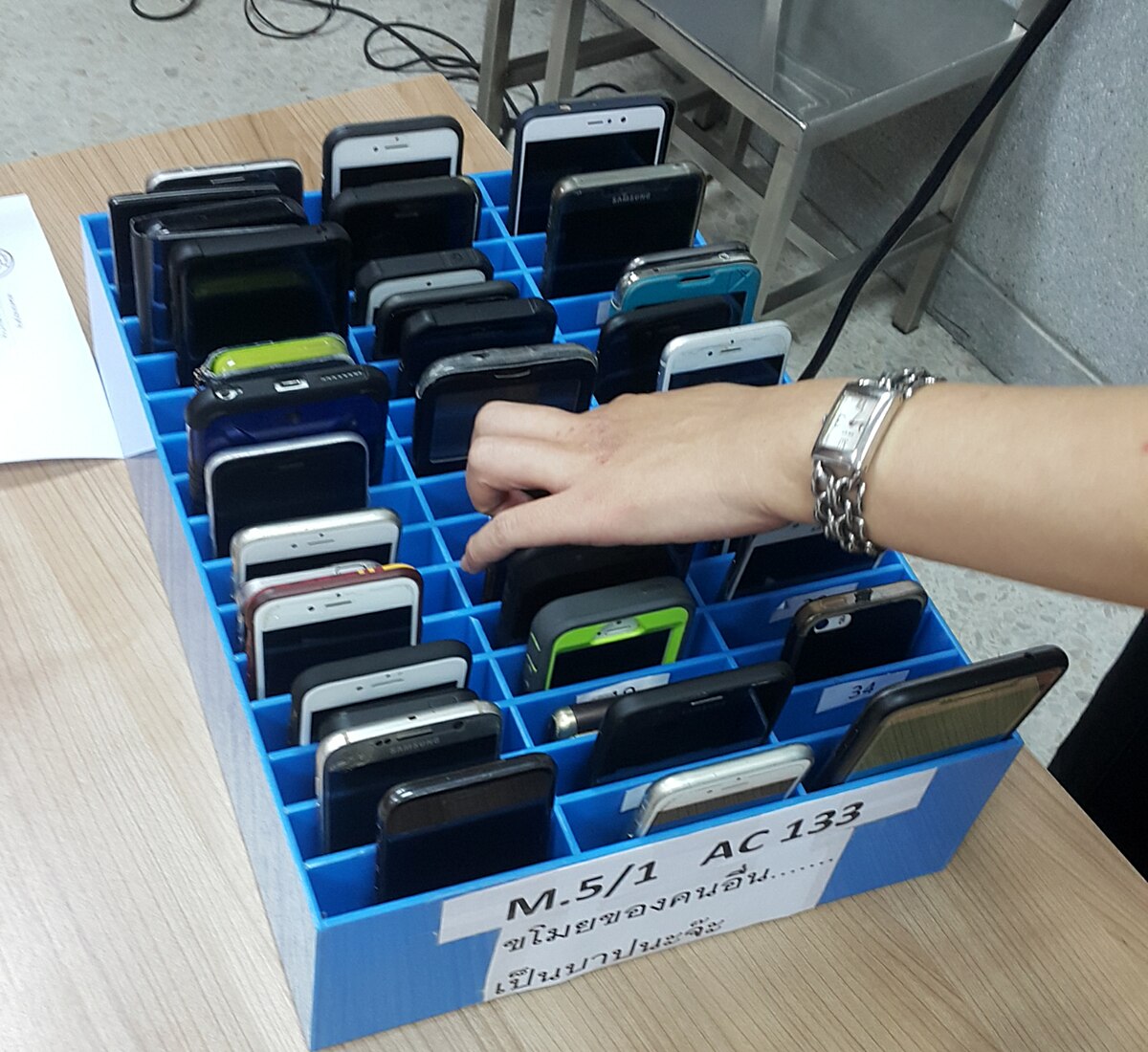
A blue plastic mobile phone cage filled with numerous smartphones, with a hand reaching in to retrieve one. Chainwit., CC BY-SA 4.0, via Wikimedia Commons
Why is it not officially classified as an addiction?
The Diagnostic and Statistical Manual of Mental Disorders does not list problematic smartphone use as an official psychiatric diagnosis. Researchers introduced the label because many people experience compulsive patterns and distress without meeting the strict criteria for a formal behavioral addiction. Standardized treatments do not exist due to a lack of expert consensus, conflicting diagnostic manuals, and the impossibility of testing phone habits in animal models.
Studies do show statistical associations between heavy screen time and issues like inattention, hyperactivity, and low self esteem in children and adolescents. However, researchers have not established direct causality. Media reports often overlook these nuances, presenting broad correlations as direct proof of harm.
How do researchers measure excessive phone use?
Estimated rates of problematic phone use vary widely across the world, ranging from under 10% to over 40% depending on the specific diagnostic test applied. Researchers track these behaviors using standardized questionnaires such as the 20-item Problematic Use of Mobile Phones (PUMP) scale and the Mobile Phone Problem Use Scale (MPPUS).
A driver using a mobile phone represents a physical hazard caused by engaging with devices in inappropriate settings. Mike W., CC BY-SA 2.0, via Wikimedia Commons
Context determines whether heavy screen time is harmful. A global survey across 195 countries found that extensive use for professional tasks does not carry the same negative impact as usage that disrupts sleep, damages relationships, or occurs in dangerous situations like driving.
Test yourself
How does problematic smartphone use respond best to interventions, according to the mechanics of habits?
By altering physical cues and distance. Because phone checks are habits driven by cues rather than conscious desires, they respond best to environmental changes like grayscale or distance that disrupt the cue rather than relying on resolve.
Is problematic smartphone use driven primarily by long, deliberate sessions or by brief, reflexive checks?
Brief, reflexive checks. Problematic smartphone use is composed mostly of quick checks under thirty seconds rather than long intentional sessions. These checks start as automated habits tied to cues rather than conscious wants.
A habit survives every resolution you make about it. What usually breaks it?
Changing what is within reach. A habit runs off a cue and does not consult the part of you making resolutions. Move the cue or the payoff and the sequence has nowhere to start, which takes no willpower at the moment it matters.
Play the lesson in edgi and the card is yours. It lands on your Map next to the ideas it connects to, and turns from matte to foil to gold as you learn more around it.
Yes, research indicates distinct usage patterns across genders. Studies show that females are more likely to overuse social media, while males are more likely to overuse video games.
What is the simplest way to reduce phone checks?
Changing the environment works better than willpower. Putting distance between the reflex and the device, such as switching the display to grayscale or charging the phone in another room, weakens the cue that triggers the habit.